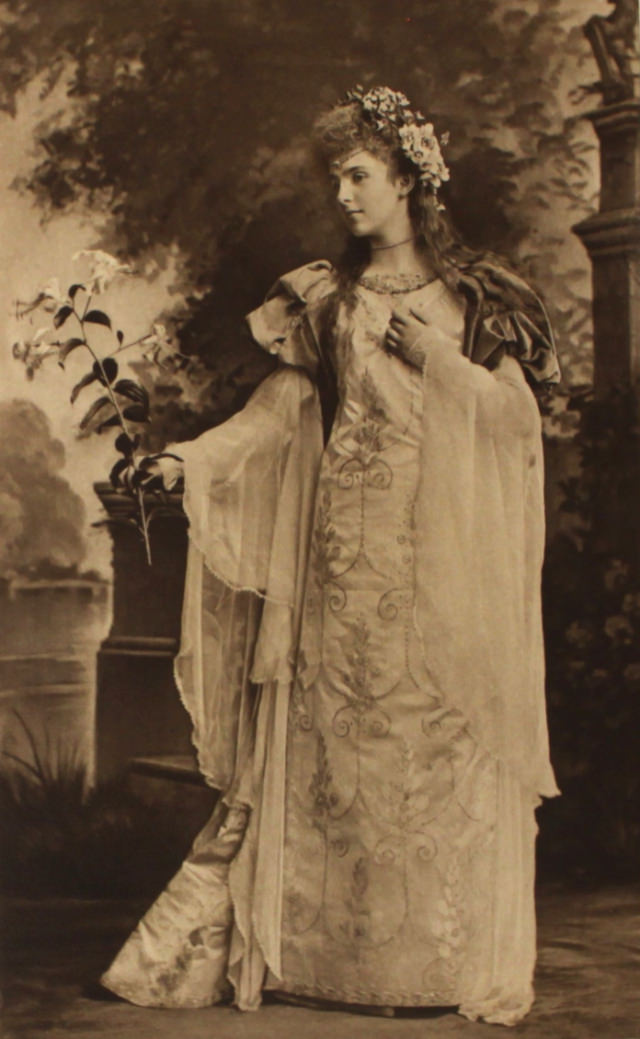
Elegance is staged like a tableau: Lady Alice Montagu stands in profile beside a stone balustrade, one hand resting near her bodice while the other lightly meets a flowering branch. Her gown falls in a long, pale column, embroidered with curling motifs and softened by billowing, translucent sleeves that trail with theatrical grace. A floral headpiece crowns her hair, lending the portrait a romantic, garden-lit air that suits the medieval inspiration of her chosen persona.
Costume portraits from grand society balls were more than fancy dress; they were careful performances of lineage, literature, and taste. Here she appears as Laure de Sade—linked by tradition to the family of the Marquis de Sade and, in popular imagination, to the elusive “Laura” celebrated by the poet Petrarch. The image leans into that legend through gentle symbolism: blossoms, drapery, and a serene, distant gaze that suggest courtly love and poetic reverie rather than modern realism.
As part of the celebrated Devonshire House Ball of 1897, the photograph also speaks to late-Victorian fascination with historical revival—an era when medieval and Renaissance references could be worn as cultural capital. The studio backdrop of foliage and classical architecture frames her like a painting, blending photography with the aesthetics of portraiture. For fashion and culture historians, this is a rich example of how aristocratic spectacle turned the past into wearable storytelling, preserving a moment when costume, status, and myth converged in a single pose.