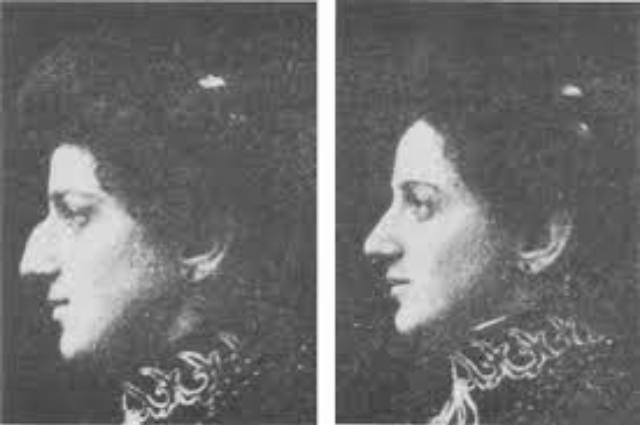
Two grainy side-profile portraits sit shoulder to shoulder, inviting an immediate comparison that feels both clinical and intimate. The same woman appears in each frame, her dark hair pinned back and her high, patterned collar anchoring the era’s fashion sensibilities. What changes is the silhouette of the nose—subtly reshaped in the second view—turning the diptych into a quiet “before and after” that reads like an early cosmetic surgery record.
In the 1920s and 1930s, rhinoplasty moved from the margins into broader public awareness, propelled by modern medicine, shifting beauty ideals, and the growing influence of mass media. Profile became a fixation: a clean line from brow to tip, a softer bridge, a more “refined” contour that photographs well and matches the period’s sleek, streamlined look. Images like this one straddle two worlds at once—part medical documentation, part cultural artifact—showing how a private decision could be framed as self-improvement in an age newly obsessed with appearances.
Beyond the operating room, the photo echoes the fashion and culture pressures of the interwar years, when cosmetics, cinema, and magazines helped standardize what was considered attractive. The tight crop and consistent pose suggest a controlled setting, as if the face were being measured against an ideal rather than simply portrayed. Seen today, the paired profiles offer a window into early twentieth-century cosmetic history: not only what surgeons could do, but why so many people felt compelled to change, one carefully altered line at a time.