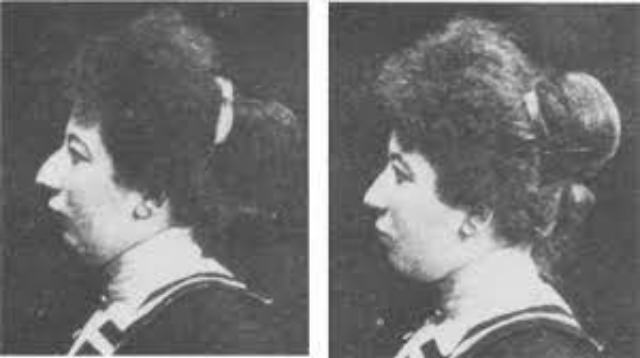
A paired set of profile portraits places the viewer in the era when rhinoplasty was becoming a more talked-about feature of modern life. The woman appears twice, each time in side view, her hair swept back into a tidy bun and her collar and dress rendered in the soft grain of early photographic reproduction. By presenting two nearly identical poses, the composition invites comparison of facial contours—especially the bridge and tip of the nose—highlighting how surgeons and patients began to define “improvement” in precise, visible terms.
Side-by-side imagery like this functioned as both evidence and advertisement, a quiet argument that a changed silhouette could signal refinement, confidence, or social ease. In the 1920s and 1930s, cosmetic surgery sat at the intersection of medicine, beauty culture, and shifting ideas of identity, with fashion magazines and popular media helping to normalize the idea of elective alteration. The consistent hairstyle, lighting, and posture here suggest an intent to keep everything else constant so the nose alone becomes the story.
Beyond the clinical “before-and-after” logic, the photograph speaks to the broader pressures of the period—how modernity asked faces to conform to fashionable standards just as clothing and cosmetics did. It also hints at the private choices behind public appearances: a procedure undertaken not only for aesthetics but sometimes to align with workplace expectations or to avoid unwanted scrutiny. For anyone exploring rhinoplasty history, 1920s beauty ideals, or the cultural roots of cosmetic surgery, this image offers a compact, compelling window into how transformation was documented and sold.