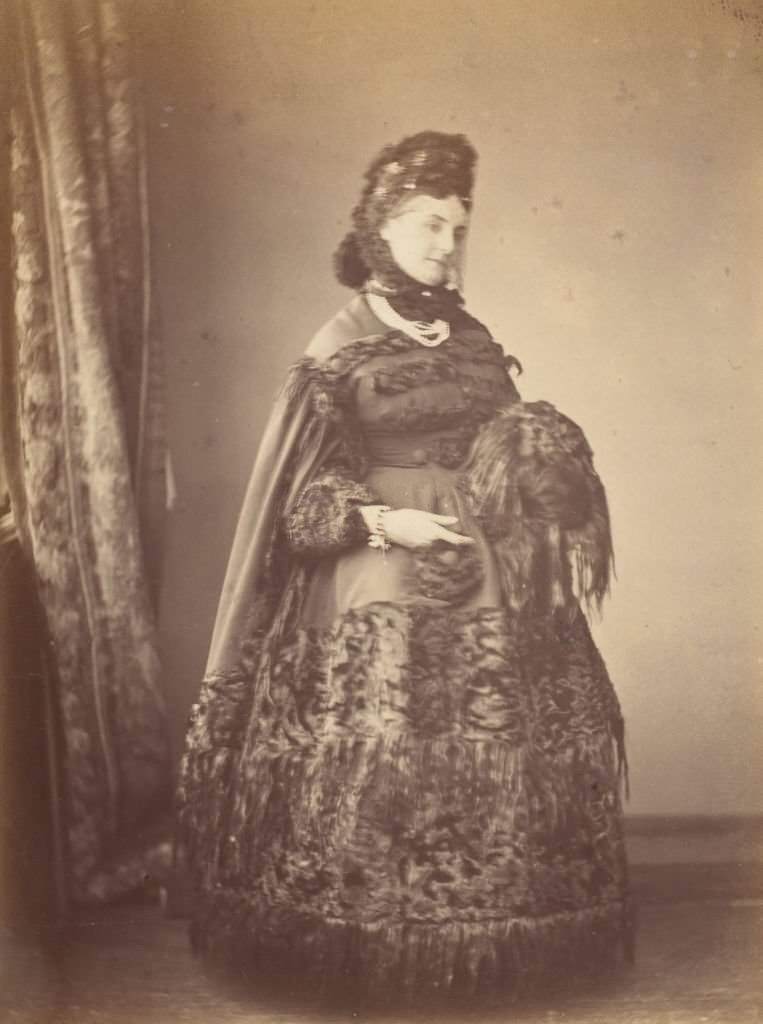
Against a plain studio backdrop, a fashionable woman of the 1860s stands in three-quarter pose, her silhouette shaped by the era’s crinoline. The bell-like skirt spreads outward in layered richness, while the fitted bodice and mantle draw the eye upward toward a composed face framed by an elaborate headpiece. Soft focus and gentle lighting lend the portrait a hushed, almost theatrical stillness typical of mid-19th-century photography.
“Le Caracul (L’Astrakhan)” points to the luxurious texture on display: the distinctive, tightly curled fur prized in European fashion as both trim and statement. It appears in generous bands around the skirt and in the muff she holds, turning practical warmth into conspicuous elegance. Alongside the fur, careful details—lace at the cuffs, a bracelet at the wrist, and a light necklace at the throat—signal a taste for refinement and a wardrobe built to be seen.
More than a costume study, the photograph reads as a small document of fashion and culture, where materials, posture, and accessories express social aspiration. The crinoline’s architecture announces modernity and status, while Astrakhan fur evokes global trade and the prestige of imported or specialty textiles in the 19th-century wardrobe. In this quiet studio moment, the sitter becomes a living catalogue of 1860s style, balancing grandeur with restraint.