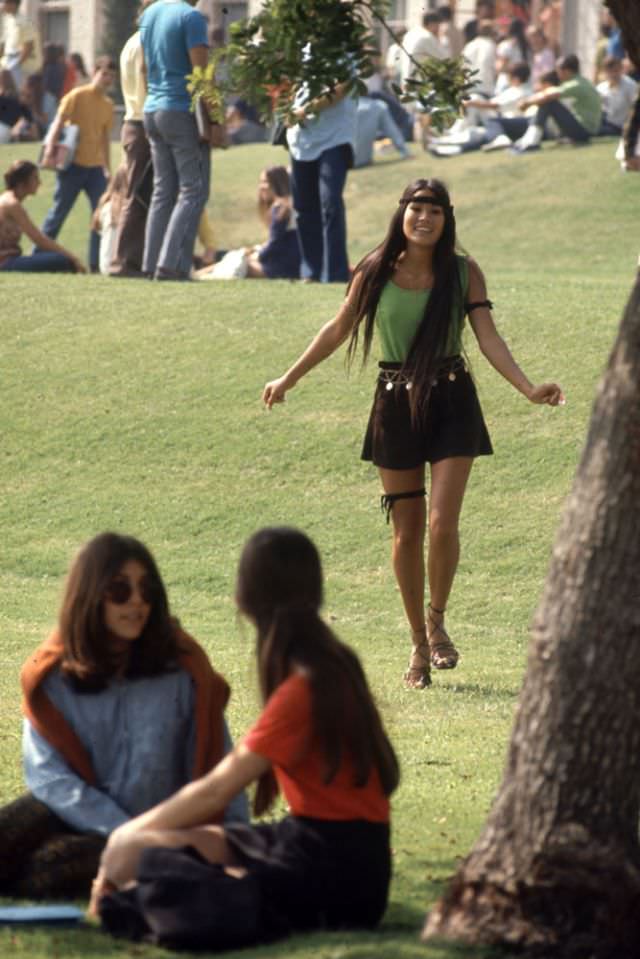
Sunlit grass slopes across a Southern California campus as students lounge in small clusters, turning an ordinary school day into a casual outdoor commons. In the middle distance, one teenage girl walks toward her classmates with an easy, open stride, her long hair flowing and a thin headband framing her face. The scene feels like a snapshot of late-1960s youth culture—informal, social, and shaped by the warm climate that made lawns and courtyards as important as classrooms.
Her outfit anchors the moment: a “Mini Jupe” skirt worn with a bright sleeveless top, accessorized with a hip belt and strapped sandals, reading both playful and fashion-forward for 1969. A band at the upper arm and the confident, almost runway-like walk suggest how trends were tried on in real time at school, not just in magazines. Around her, other teens in jeans, T-shirts, and sunglasses create a textured backdrop of everyday style, underscoring how quickly the mini skirt had become part of the era’s visual language.
Beyond the hemlines and accessories, the photograph hints at shifting attitudes about self-expression, dress codes, and what counted as “appropriate” in public education at the end of the decade. The relaxed poses of classmates—some sitting cross-legged on the grass, others standing and chatting—capture a campus atmosphere that feels both communal and distinctly West Coast. As a piece of fashion history and student life, it preserves a fleeting moment when the mini skirt symbolized modernity, youth confidence, and the changing rhythms of American high school culture.