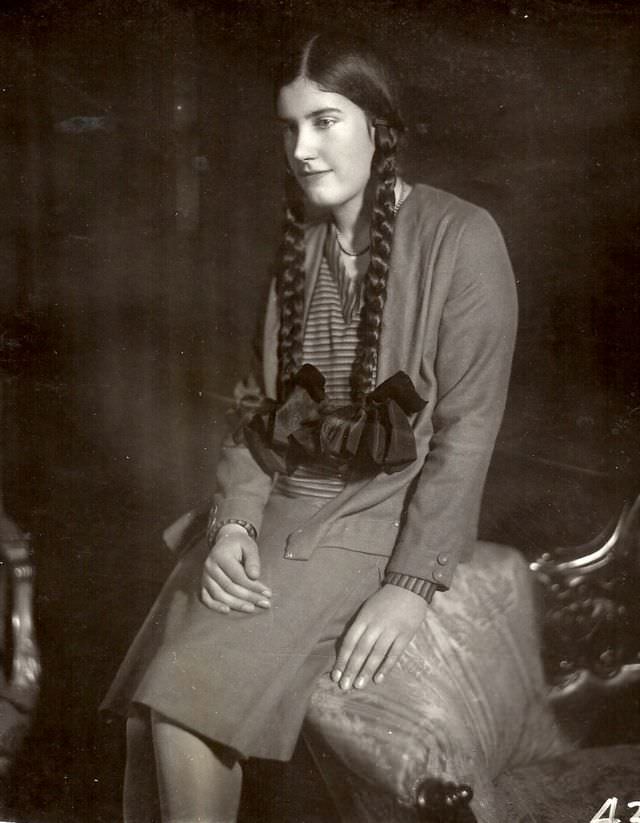
Soft studio lighting falls across a seated young woman, her gaze turned slightly aside as if caught between posing and private thought. The portrait emphasizes texture and line: long, neatly parted hair is worn in two thick braids, while her hands rest calmly on her lap, one wrist marked by a watch or bracelet that hints at modern habits. Behind her, an upholstered chair and a dark backdrop keep attention fixed on face, posture, and clothing.
Fashion details place the image comfortably within the 1920s mood celebrated in Melbourne’s flapper-era culture, even as her look leans modest rather than overtly flamboyant. A tailored coat with buttons and a striped dress or blouse underneath suggests the practical elegance of the decade, and the large bow at her chest adds a deliberate, decorative statement. The overall silhouette favors straight lines and relaxed structure, reflecting the era’s shift away from rigid Edwardian formality toward youth, comfort, and self-expression.
More than a simple likeness, the photograph reads as a quiet record of changing women’s style and identity in interwar Australia. It speaks to the everyday glamour of the time—how accessories, careful grooming, and confident bearing could transform a studio sitting into a declaration of taste. For readers drawn to 1920s Melbourne fashion and culture, this portrait offers an intimate glimpse of the period’s modern spirit rendered in restrained, human scale.