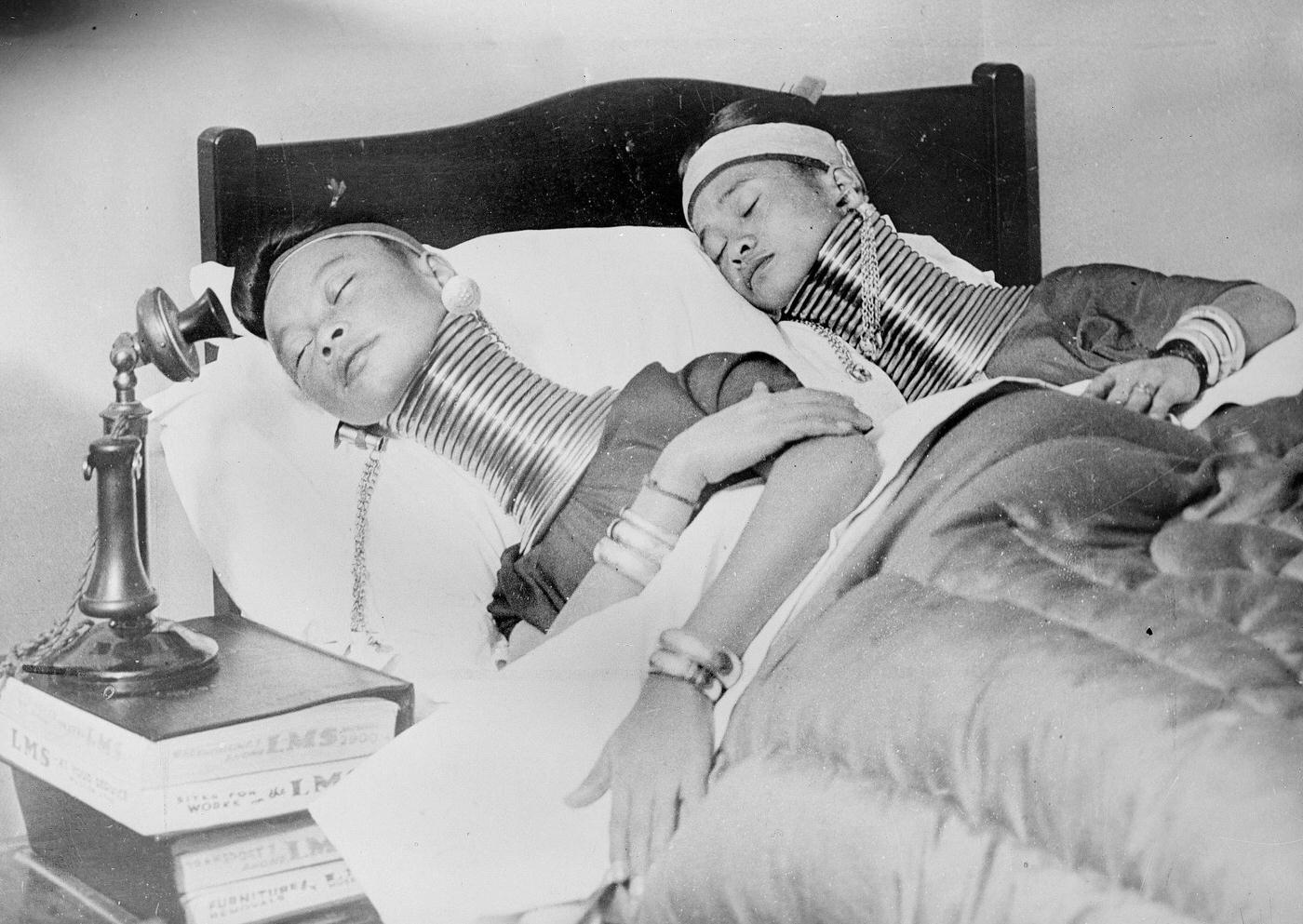
Two women lie asleep side by side in a London bed, their heads turned toward the pillow and their hands relaxed under a heavy coverlet. The camera lingers on the distinctive brass neck coils that rise in gleaming bands from collarbone to jaw, catching the light against dark garments and stacks of bangles. At the bedside, a small table holds a candlestick-style telephone atop books, grounding the scene in an everyday interior rather than a staged studio backdrop.
Known in popular Western captions of the era as “giraffe women,” they are associated with the Kayan Lahwi tradition of wearing neck rings, a form of adornment that outsiders often reduced to spectacle. Here, the contrast between the intimate act of resting and the public curiosity implied by the label reveals a quieter truth: travel and display could include long hours of ordinary fatigue, not just posed portraiture. The photo’s close framing invites viewers to notice texture and detail—metal spirals, fabric folds, and the soft wear of personal jewelry—without the distance of a formal ethnographic tableau.
As a 1930 London image, it also speaks to the city’s appetite for “exotic” culture in the interwar years, when performers and visitors from across the British Empire were frequently presented through simplified narratives. The bedside telephone and printed volumes hint at modernity and commerce surrounding the encounter, while the women’s peaceful faces resist the sensationalism of the caption. For anyone searching for historical photographs of Kayan neck rings, Burma in Western archives, or London’s cultural exhibitions, this moment offers an unusually human, domestic view of fashion, identity, and the gaze of the metropolis.