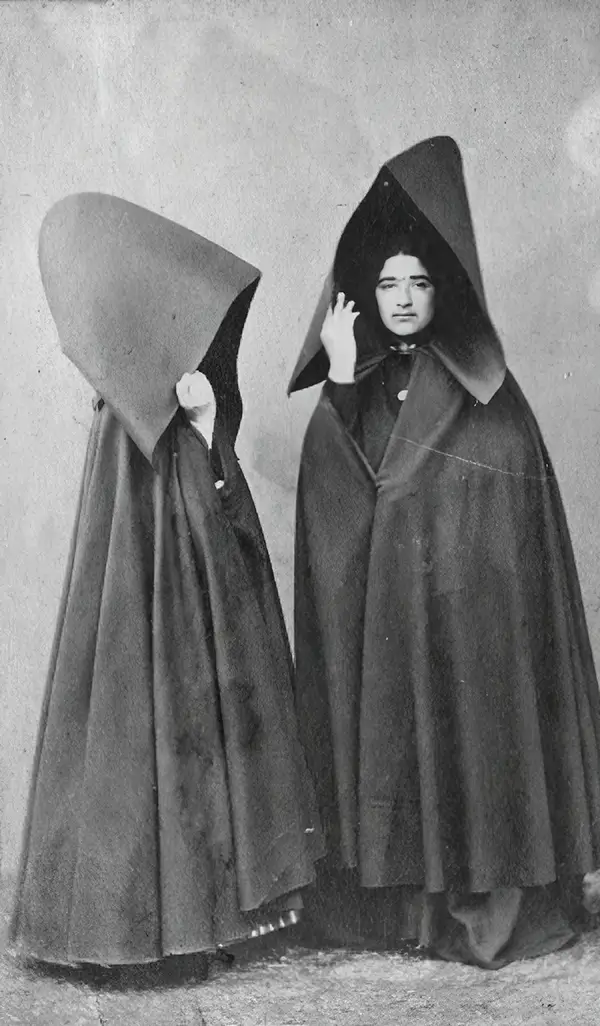
Two women stand against a plain studio backdrop, their bodies wrapped in heavy, dark capes that fall in clean, uninterrupted lines to the ground. The most striking feature is the towering hood, shaped like a stiffened cone that frames the face on one figure and nearly swallows the other in shadow. In this quiet pose, the Azorean hooded cape becomes both garment and architecture, turning everyday clothing into a dramatic silhouette meant to be seen.
On the right, the sitter meets the camera directly, one hand raised near her cheek as if adjusting the edge of the hood or holding it in place. The cape’s broad surface catches soft light, revealing subtle folds and a faint seam line that hints at careful tailoring, while the other woman’s face remains hidden, emphasizing anonymity and modesty. Details are minimal—no jewelry, no elaborate setting—so the viewer’s eye stays on shape, texture, and the remarkable profile of the traditional head covering.
Beyond its theatrical outline, this traditional Portuguese women’s fashion speaks to island life and the practical poetry of dress: protection from wind and weather, privacy in public spaces, and a visual language of community identity. Historical photos like this one preserve the Azorean hood as more than costume, documenting how clothing carried social meaning and local craftsmanship across generations. For anyone exploring Portuguese culture, Azores heritage, or the history of women’s attire, the hooded cape remains an unforgettable emblem of regional style.