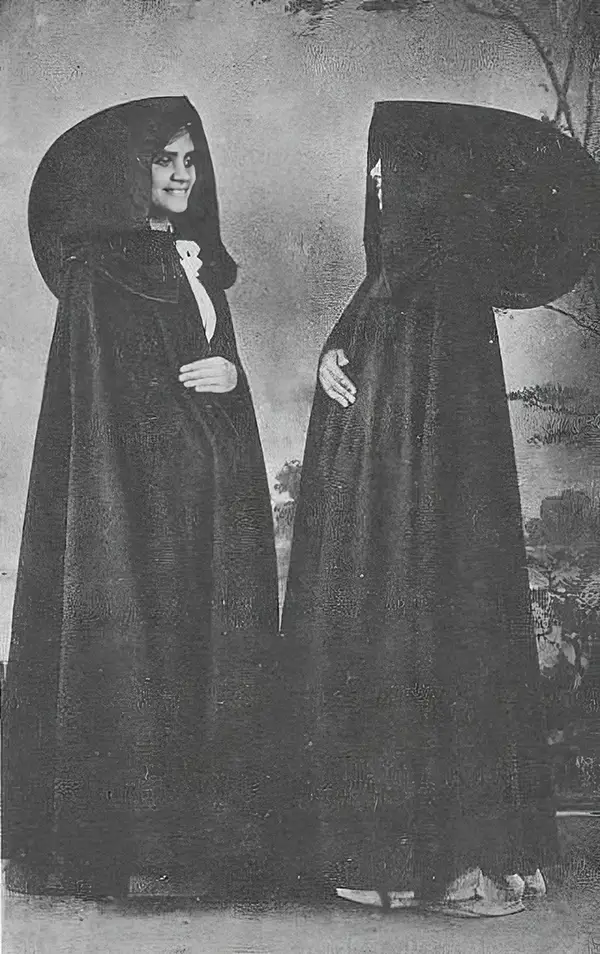
Two women stand poised in traditional Azorean dress, their long dark capes falling in heavy folds from shoulder to floor. Each wears the distinctive hooded cape—often called the Azorean hood—its exaggerated, boxy silhouette framing the head like a portable canopy. One figure turns slightly toward the camera with a reserved smile, while the other faces away, letting the garment’s shape speak for itself.
The clothing’s drama lies in its contrasts: a dense, almost architectural hood set above a soft cascade of fabric, with a pale blouse or neck detail briefly catching the light beneath the cloak. These capes were more than striking fashion; they offered warmth against Atlantic winds and a measure of privacy in public spaces, blending practicality with an unmistakable local style. Even in a studio-like setting, the garments evoke island streets, church steps, and everyday routines where tradition was worn as naturally as a coat.
Fashion historians often point to the Azorean hood as one of Portugal’s most recognizable regional costumes, instantly legible in silhouette alone. Photographs like this preserve details that written descriptions can’t fully convey—the way the hood casts shadow across the face, the careful hand placement at the cape’s edge, the quiet confidence of women inhabiting a cultural identity through cloth. For readers searching Azores heritage, Portuguese traditional clothing, or historic women’s fashion, the image offers a compelling glimpse of how regional culture was stitched into daily life.