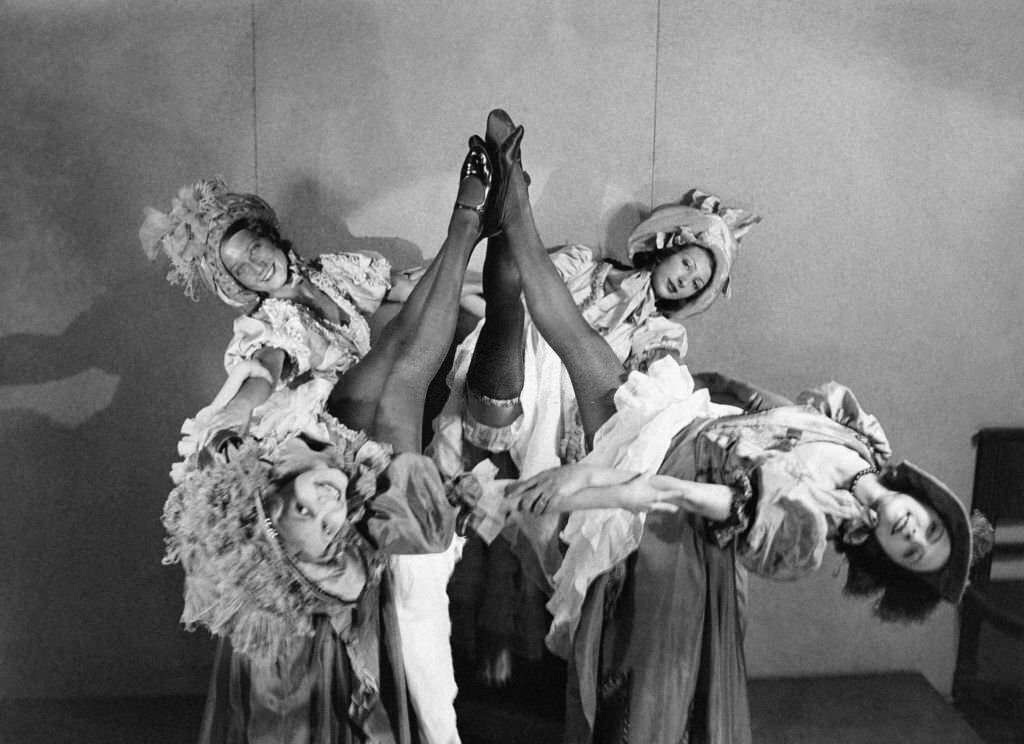
Four cancan dancers freeze in a daring, comic tangle, their bodies fanned outward as two legs shoot straight up to form a sharp V in the center. Ruffled skirts, layered petticoats, and ornate headpieces spill across the frame, while dark stockings and glossy shoes emphasize the precision of the kick. Set against a plain studio-like wall, the pose feels both theatrical and intimate, as if the curtain has lifted on the backstage bravado of a Paris cabaret.
Costume details do much of the storytelling: lace-trimmed sleeves, gathered fabric, and feathered or flowered millinery evoke the exuberant world of French nightlife in the early 1930s. The performers’ expressions—part smile, part concentration—hint at the athletic strain behind a routine famous for speed, balance, and synchronized legwork. Even without a visible stage, the styling and choreography point unmistakably to the cancan’s blend of flirtation, humor, and disciplined technique.
Titled “French cancan dancers in a cabaret, in Paris, 1933,” the photograph reads like a snapshot of interwar entertainment culture, when cabarets sold spectacle as much as music. Its crisp contrast and carefully held formation make it highly searchable for themes such as Paris cabaret history, 1930s fashion, French dance, and the evolution of performance costume. More than a playful tableau, it preserves the physical daring and visual excess that turned the cancan into a lasting symbol of Parisian nightlife.