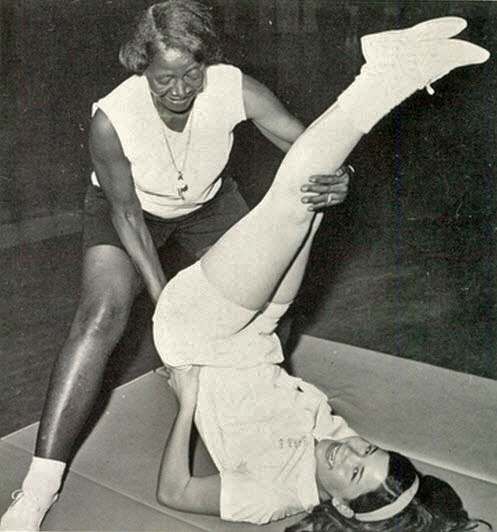
An unexpected gym-floor tableau sets the tone: one woman braces herself and hoists another’s legs straight up, turning what could be a routine stretch or exercise drill into something that reads, to modern eyes, like a wink. The contrast between effort and composure—hands firmly positioned, bodies angled for leverage—creates a moment that’s both athletic and unintentionally theatrical. It’s the kind of candid-looking scene that makes you pause and ask whether the original audience saw only “health” and “fitness,” or caught a mischievous undertone.
Old-school ads, comics, and catalog images often lived in that hazy space where wholesome messaging met suggestive visual language, especially when bodies and clothing were used to sell an idea. Here, the pose feels like a gag from a bygone humor column, yet it also resembles legitimate conditioning or demonstration work, the sort of thing that could be framed as perfectly proper. That ambiguity is exactly where double meanings thrive: the camera freezes a split second that can be read as innocent instruction or cheeky innuendo, depending on the viewer’s expectations.
For fans of vintage humor and pop-culture oddities, this post leans into the “Innocent or Not?” question with an eye toward how visual jokes slip through the cracks of their own era. The fun is in decoding the subtext—what was likely meant to be straightforward versus what accidentally became suggestive over time. If you enjoy exploring surprising double meanings in old advertising, retro comics, and quirky catalog art, this kind of image is prime evidence that yesterday’s “clean” content wasn’t always as simple as it seemed.