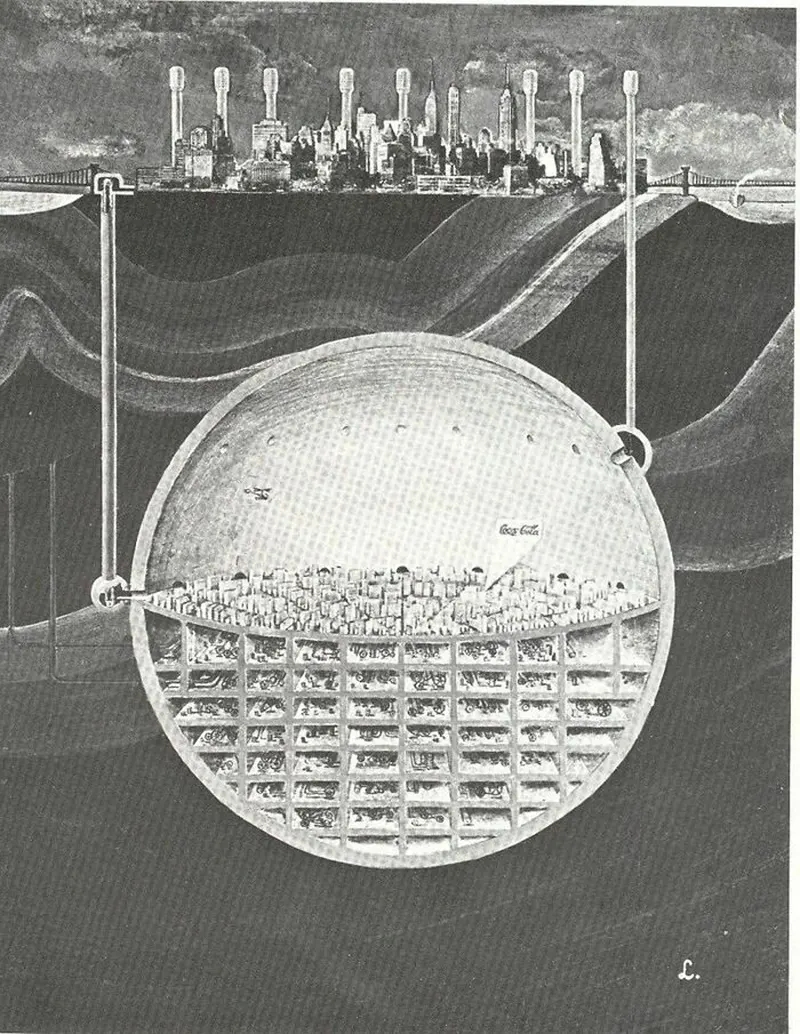
Cold War imagination runs wild in this 1969 concept of a “nuke-proof underground city” beneath Manhattan, where the familiar skyline sits above a dark, layered cross-section of earth like a lid on a buried machine. The drawing contrasts what the public sees—towers, bridges, and a crowded horizon—with what it proposes below: a vast, sealed sphere suspended underground, fed by thick vertical shafts that resemble lifelines.
Inside that circular chamber, tiny buildings and stacked, gridlike compartments suggest an entire metropolis reorganized into engineered layers—housing, storage, circulation, and services compressed into a single protective volume. The cutaway style reads like a survival manual rendered as urban planning, implying air handling, access tunnels, and controlled entry points while keeping the “surface city” intact above.
Ideas like this help explain the era’s blend of optimism and dread, when nuclear anxiety inspired designers to treat cities as systems that could be rebuilt, moved, or armored. For readers searching “underground Manhattan,” “Cold War city plans,” or “nuclear shelter concept art,” the image is a striking reminder that mid-century futurism often lived in the shadow of catastrophe, and sometimes answered it with audacious architecture rather than politics.