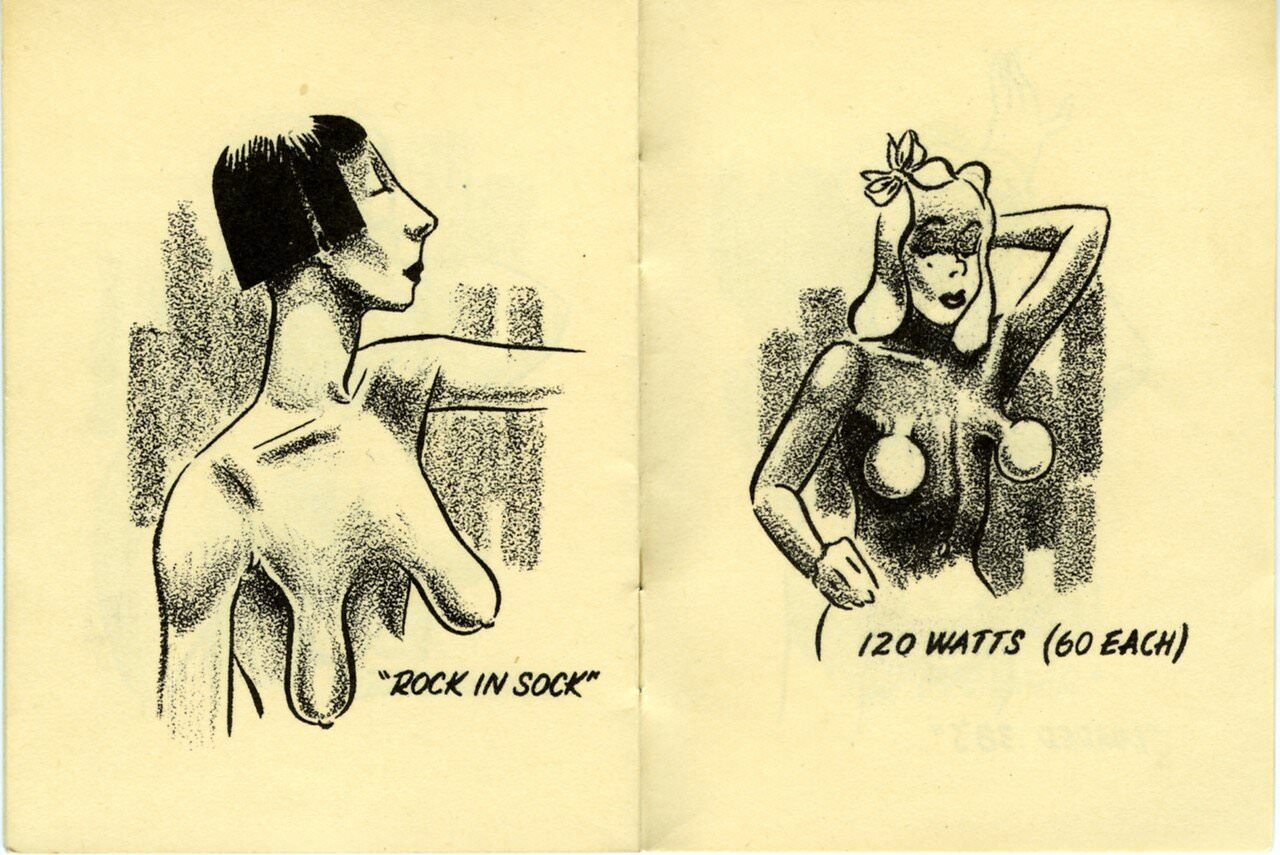
Odd little jokes sometimes survive longer than grand speeches, and “Rock in Sock or 120 Watts (60 each)” feels like exactly that kind of artifact. The page shows two playful, hand-drawn figures posed like fashion sketches, with the captions “ROCK IN SOCK” on one side and “120 WATTS (60 EACH)” on the other. Rendered in simple lines and stippled shading on yellowed paper, it reads like a humorous doodle meant to be shared, folded, and passed along.
On the left, the figure’s exaggerated silhouette leans into cartoonish anatomy, while the right-hand character strikes a pin-up style pose with a bow perched above the hair. Together they create a visual punchline: a choice between the crude, improvised “rock in a sock” idea and the cheeky, modern-sounding “120 watts” comparison. The contrast hints at the way slang and innuendo borrow from whatever objects feel familiar—streetwise weaponry on one side, household electricity on the other.
Humor like this is also a window into the everyday culture that rarely makes it into official archives, especially when it’s tucked into anonymous sketchbooks, barracks notebooks, or back-pocket stationery. For readers interested in vintage humor, risqué cartoons, and the language of old jokes, this image offers plenty to linger over—both in the drawings and in the phrasing. Even without firm details about who drew it or where it originated, the gag remains legible: a wink, a dare, and a bit of period slang preserved on paper.