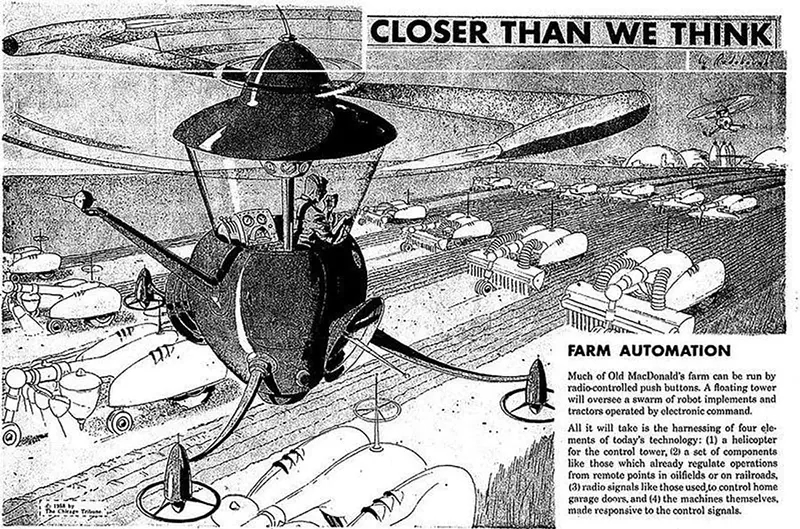
A headline at the top—“CLOSER THAN WE THINK”—sets the tone for a mid-century daydream about tomorrow’s countryside, where fields stretch in neat bands and machines do the hard labor with barely a person in sight. The drawing leans into the futuristic mood with a bulbous, helicopter-like craft hovering over the farm, its glassy cockpit suggesting oversight and control rather than sweaty hands on a plow. Even without pinning down a specific place, the scene reads as an optimistic snapshot of how people in 1958 imagined “farming in the 21st century.”
Across the landscape, rows of automated tractors and rounded, capsule-shaped implements move in formation, turning agriculture into something closer to an assembly line. The accompanying copy labeled “FARM AUTOMATION” talks up radio control, electronic commands, and swarms of implements—language that blends space-age excitement with practical ambition. It’s funny in the way vintage futurism often is: grand promises, streamlined shapes, and the belief that complexity could be mastered from a single control point.
Seen today, the humor lands alongside a real historical insight about technology, labor, and efficiency in postwar farming culture. This 1958 vision anticipates modern precision agriculture—remote monitoring, automation, and the drive to optimize every acre—even if the aesthetics belong firmly to the era of sci-fi illustration. For readers searching for retro future art, farm automation history, or 1950s predictions of the 21st century, the image offers a lively reminder that tomorrow has always been something we tried to sketch in advance.