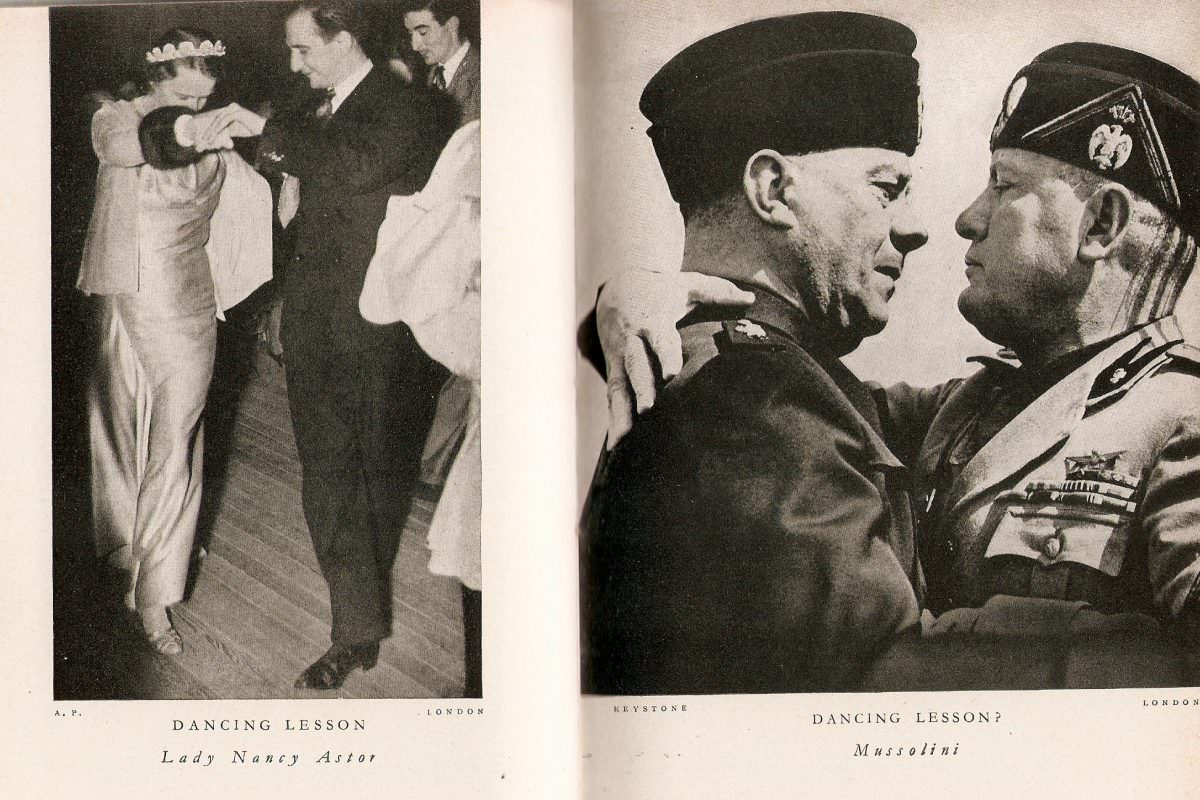
Lady Nancy Astor appears mid-step in an evening gown as a suited partner guides her through a “dancing lesson,” the caption below leaning into the playful social-page tone. The angle catches the choreography of high society—poised posture, careful hand placement, and the quiet confidence of a woman accustomed to public attention. Even without a stated date, the fashion and staging evoke that interwar world where politics, celebrity, and nightlife easily shared the same ballroom.
Across the spread, the mood flips from graceful to pointed: Mussolini is presented in uniform, locked in an intense face-to-face embrace with another uniformed man, as if the camera has intercepted a private greeting. The photographer crops in close to emphasize expressions and insignia, turning a political figure into a study in theatrical presence. The tongue-in-cheek caption “Dancing Lesson?” makes the juxtaposition feel deliberate, inviting readers to compare the performance of charm in society circles with the performance of power in authoritarian pageantry.
Together, these paired images work like a miniature editorial—humor first, then discomfort, with both built from gesture and staging rather than words. For anyone searching for Lady Nancy Astor photos, Mussolini historical images, or interwar political culture, the spread offers a compact reminder of how period magazines blurred entertainment and propaganda. It’s “funny” on the surface, yet the joke lands because the era itself often treated public life as a kind of dance, with consequences far beyond the floorboards.