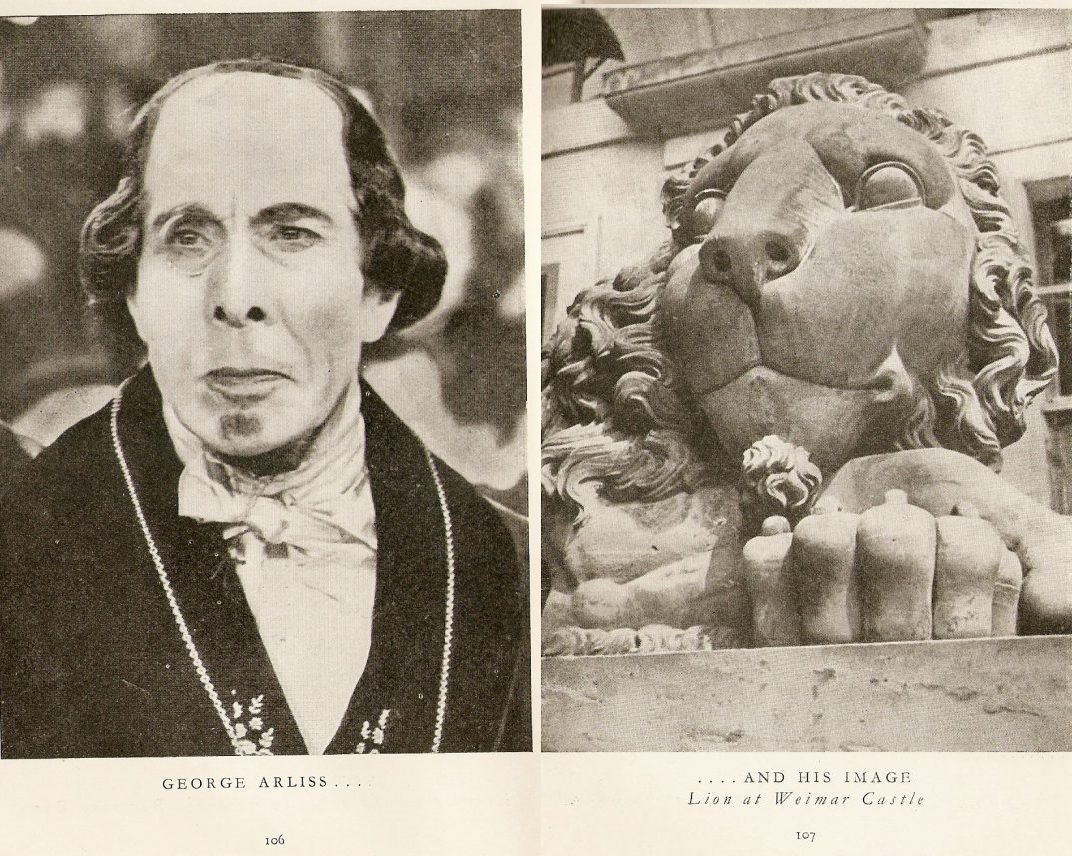
George Arliss appears here in a tight, dramatic portrait, his face lit to emphasize the arched brows, pursed lips, and the carefully arranged formalwear that helped define his screen presence. The styling reads as theatrical and deliberate—an actor’s mask made real—inviting you to linger on the subtle expression and imagine the voice and cadence that audiences would have known. It’s a wonderfully intimate piece of classic film-era imagery, the kind that turns a familiar name into a living, breathing personality.
Across the page, the mood pivots into playful irony with a close view of a lion at Weimar Castle, all broad muzzle, heavy-lidded eyes, and carved mane. The framing gives the sculpture a startling sense of character, as if it has its own stage presence to rival the actor’s. Placed side by side, Arliss and the lion become an accidental double act—human gravitas on one panel, stone grandeur on the other—making the “Funny” note feel earned without forcing the joke.
Collectors of vintage celebrity photos, classic cinema ephemera, and European travel imagery will appreciate how this post pairs portraiture with architectural ornament in a single memorable spread. The title, “George Arliss (and) Lion at Weimar Castle,” hints at a behind-the-scenes curiosity: a star’s image set against a symbolic guardian of place and history. For readers browsing for George Arliss photographs or Weimar Castle details, this charming juxtaposition offers both—an actor’s carefully composed likeness and a lion that still knows how to steal a scene.