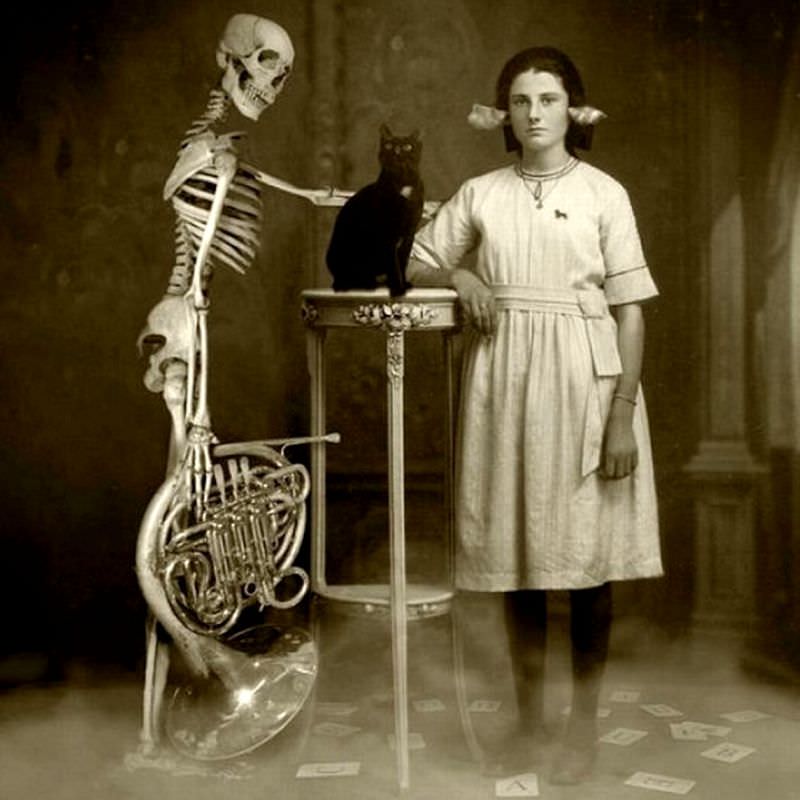
An odd little stage tableau from the 1910s pairs a young woman’s steady gaze with two companions that steal the scene: a full skeleton posed upright and a sleek black cat perched on a small pedestal table. The mood is deadpan rather than eerie, the kind of deliberate straight-faced humor that early studio portraiture could pull off so well. Even without a caption beyond “Trio,” the arrangement feels like a visual joke told with absolute seriousness.
At the left, the skeleton leans in as if part of the family, one bony arm extended toward the cat while a large brass instrument—shaped like a tuba or sousaphone—rests against its legs. Center stage, the cat sits statue-still, eyes forward, acting as the calm anchor between prank and portrait. On the right, the woman’s simple dress and pinned hairstyle frame her composed expression, making the scene’s absurdity land even harder.
Behind them, a painted studio backdrop with architectural columns and a patterned floor hints at the controlled environment where photographers built stories from props and posture. The result is both funny and strangely intimate, a snapshot of how people in the early 20th century experimented with novelty portraits, dark humor, and the theatrical possibilities of the camera. For anyone browsing vintage photography, early studio portrait oddities, or 1910s ephemera, this “Trio” offers a memorable blend of wit and period detail.