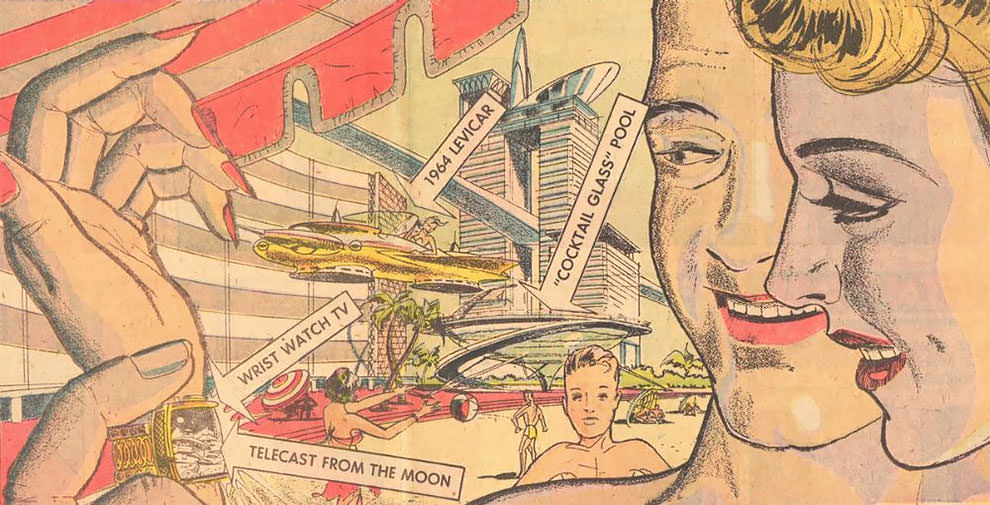
Bright, dreamlike color and swooping lines turn “Wristwatch TV” into a playful window on mid-century futurism, where tomorrow is always just around the curve. A giant hand dominates the scene, showing off a watch that promises not merely timekeeping but entertainment on demand—an early echo of today’s wearable screens and constant streaming. The exaggerated scale and glossy styling feel like an advertisement’s daydream, selling modern convenience with a wink.
In the background, a streamlined city rises behind a resort-like waterfront, complete with sunbathers, a red car, and aircraft gliding past as if traffic has taken to the skies. Labels sprinkled across the illustration—“WRIST WATCH TV,” “TELECAST FROM THE MOON,” “1964 LEVICAR,” and “COCKTAIL GLASS POOL”—read like the punchlines of a visual joke, mixing genuine technological optimism with cocktail-party fantasy. The whole composition suggests a world where leisure, consumer gadgets, and space-age headlines are part of the same stylish package.
What makes this historical image funny is how familiar its promises feel, even when the details are delightfully offbeat. The wristwatch television stands in for a broader faith in miniaturization and mobility: news and entertainment following you anywhere, not tied to a living-room set. As a piece of retro “future of technology” artwork, it’s perfect for anyone fascinated by vintage advertising, space-age design, and the long, winding path from imagination to the devices we actually wear.