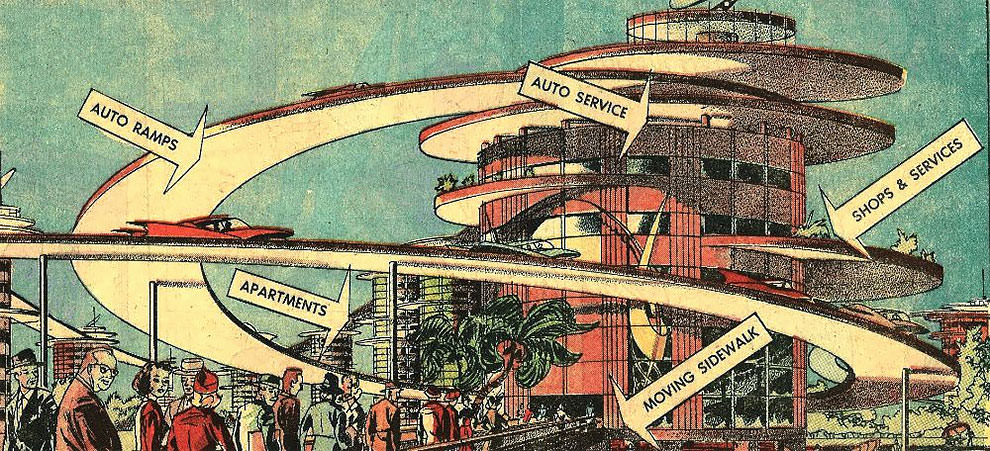
Motopia sounds like a joke, yet the artwork leans into a serious mid-century dream: a city engineered around the automobile. Sweeping elevated roadways curl like ribbons around a rounded, multi-level building, while a small crowd below moves through a plaza that feels more like a transit hub than a traditional street. The whole scene reads as a playful promise that modern life could be streamlined, spectacular, and always in motion.
Arrows in the illustration label the new urban essentials—“Auto Ramps,” “Auto Service,” “Shops & Services,” “Apartments,” and even a “Moving Sidewalk.” Those signposts do more than guide the eye; they reveal an ideology in which convenience is built into the architecture, stacking living, shopping, and maintenance into one compact, futuristic complex. Instead of hiding infrastructure, Motopia puts it on display, turning circulation and speed into the city’s defining aesthetic.
Beneath the humor of the concept lies a telling snapshot of car culture and utopian planning, when designers imagined tomorrow as a place where pedestrians and vehicles would be carefully separated and mechanically assisted. The rounded forms, bright colors, and layered decks echo the space-age optimism of retro futurism, making this a perfect image for readers interested in vintage architecture, transportation history, and visionary city planning. “Motopia” invites a smile, but it also asks what we gained—and what we surrendered—when we started building the future around the driver’s seat.