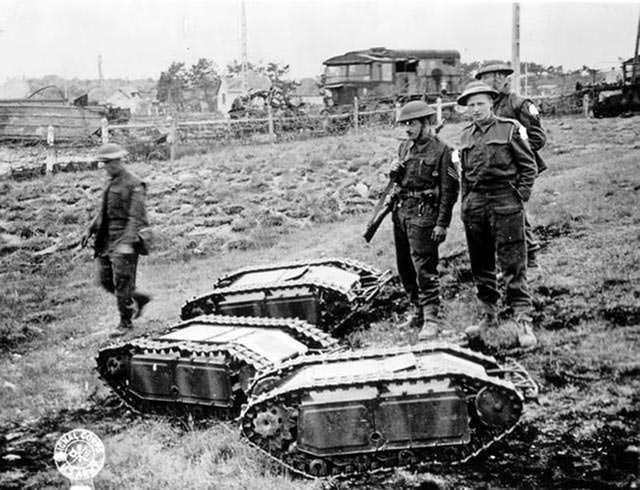
In a muddy field, British soldiers pause beside an unusual battlefield prize: captured German Goliath tracked mine carriers, often described as “tank busters” for their intended role against armor. The small, low-slung machines sit like miniature tanks, their metal casings and narrow tracks stark against the churned ground. One serviceman strolls past in the background while others linger to look, giving the moment an almost casual, curious tone amid the hard realities of wartime.
What makes the scene so striking is the contrast between the men and the technology at their feet. The Goliath was designed to be expendable—remote-controlled, packed with explosives, and sent forward to demolish obstacles, vehicles, or fortifications—yet here it lies inert and harmless, inspected at close range. The photo turns an instrument of surprise and destruction into something closer to a captured specimen, inviting viewers to notice the details: the segmented tracks, the compact chassis, and the way the machines seem built for crawling into danger.
Images like this offer a vivid window into World War II battlefield improvisation and the constant contest between innovation and countermeasures. For readers searching military history photography, British Army wartime scenes, or German Goliath demolition vehicles, the title tells the story while the photograph supplies texture—mud, machinery, and the quiet confidence of troops examining enemy equipment that didn’t achieve its purpose. There’s also a faintly “funny” edge to it: these fearsome little devices look almost toy-like when parked side by side, disarmed and out of their element.