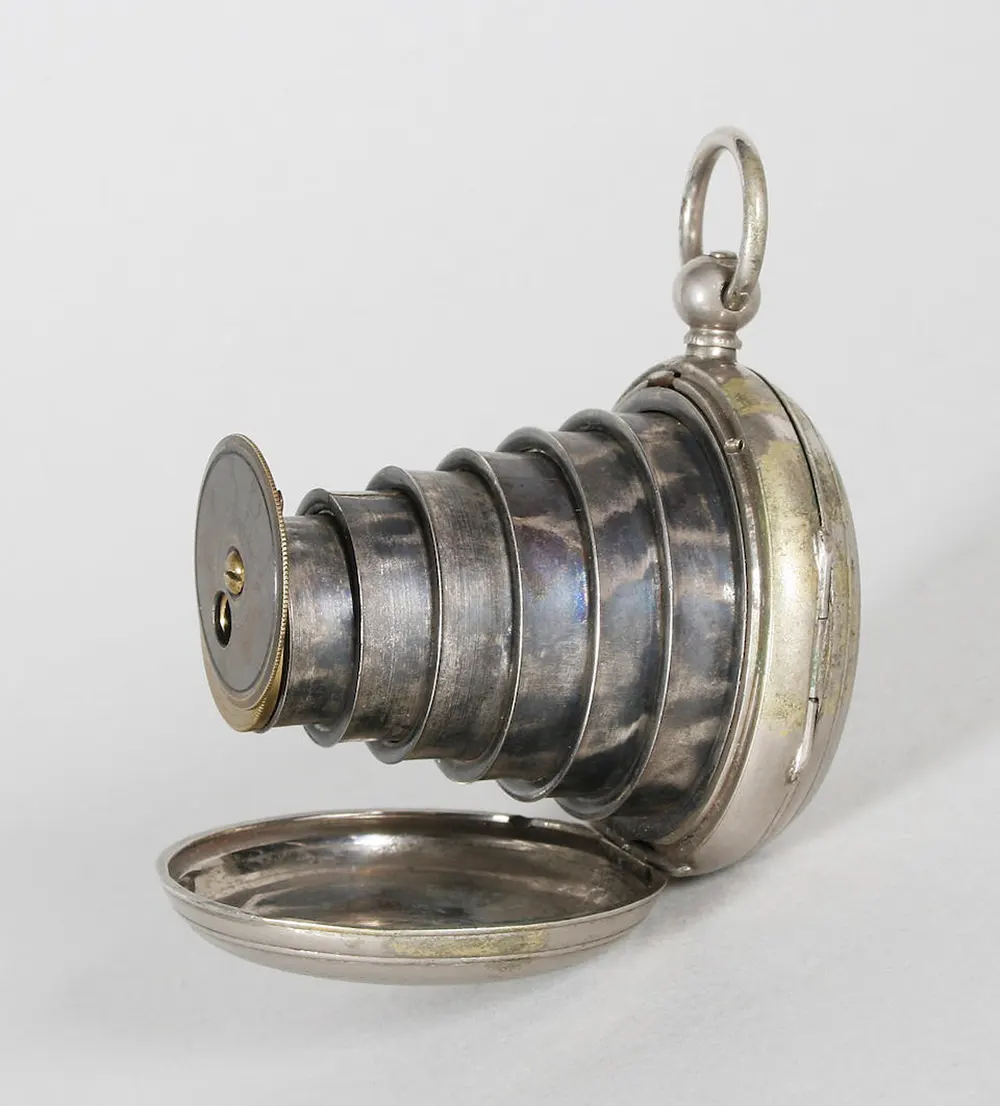
Polished metal and clever disguise meet in the Lancaster Watch Camera, a device that looks at first glance like a hefty Victorian pocket watch until its secret telescoping lens slides forward. The photo lingers on the engineering details—the ring for a chain, the rounded case, and the compact, concertina-like barrel that turns timekeeping fashion into a working miniature camera. Even the open cover reads like a familiar watch lid, quietly reimagined as part of a photographic tool.
In an era obsessed with ingenious inventions and portable marvels, this pocket-sized “spy” camera hints at how quickly photography was shrinking from studio rigs to objects you could carry. The small front plate and narrow opening suggest a deliberate focus on discretion, designed for candid scenes rather than posed portraits. For collectors and history lovers, it’s a striking example of early hidden-camera design and the Victorian appetite for gadgets that blurred the line between novelty and serious technology.
Zooming in on the wear and patina, the object feels less like a pristine museum piece and more like a companion that once lived in a coat pocket, ready to be produced at the right moment. That everyday scale is what makes the 1893 Lancaster Watch Camera so fascinating: it embodies a turning point when personal photography began to edge toward surveillance, journalism, and street life. If you’re searching for the story behind Victorian pocket cameras, antique espionage devices, or early miniature photography, this image offers a sharp starting point.