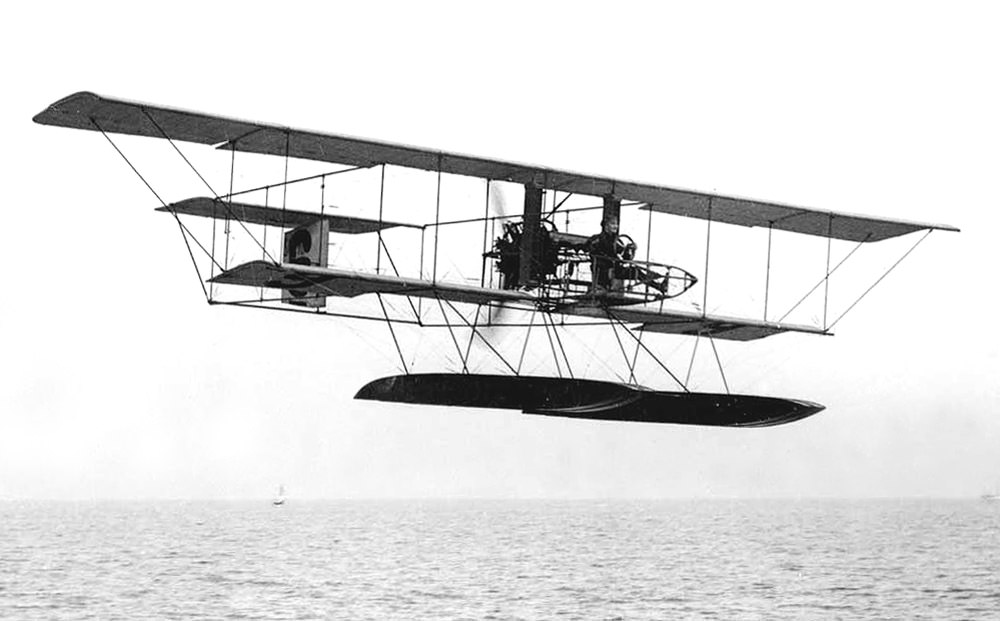
Suspended above a calm stretch of water, the Sanchez Besa aircraft from 1912 appears almost skeletal—an intricate lattice of struts and tensioned wires holding two stacked wings in perfect alignment. The open framework exposes the engine and cockpit area, a reminder that early aviation often wore its mechanics on the outside, with little separation between pilot and machine. Below, a single float-like pontoon suggests a seaplane configuration, built for takeoff and landing on water when runways were still rare.
What stands out is the confidence of the design: long, lightly cambered wings for lift, bracing everywhere for strength, and a tail assembly that looks delicate yet purposeful. The photograph’s wide, uncluttered background emphasizes the experimental nature of flight in this era—one aircraft, one horizon, and a lot of air to conquer. Even without visible markings beyond a bold character on the tail surface, the overall silhouette speaks to the rapid pace of invention and iteration happening in the years just before aviation became standardized.
For readers interested in early 20th-century inventions, this image offers a vivid snapshot of how engineers pursued practicality through simplicity—minimal fuselage, maximum wing area, and a water-capable undercarriage that expanded where aircraft could operate. It’s a compelling visual document for anyone researching pioneer airplanes, seaplane development, or the broader story of 1912 technology, when aviation still felt like a daring craft project scaled up to the size of the sky.