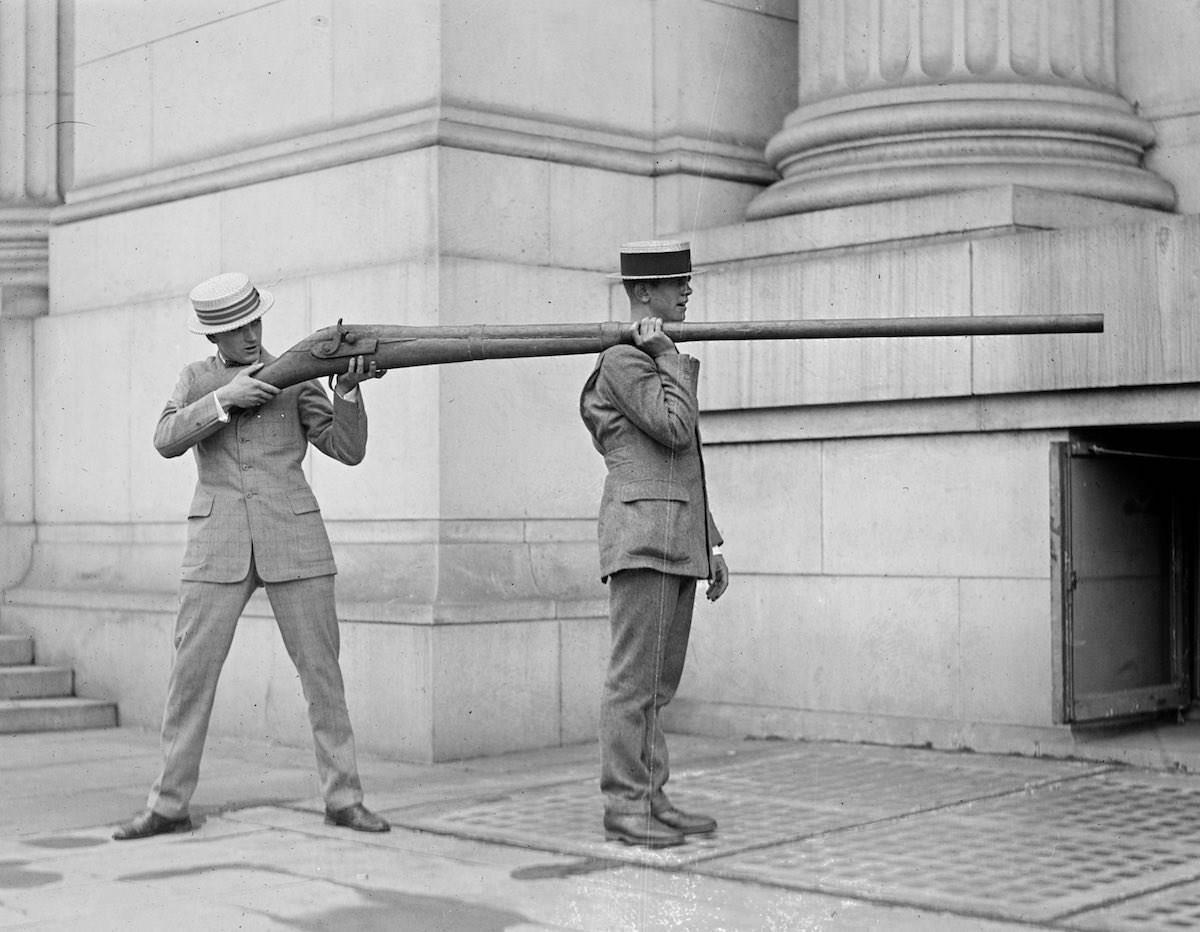
Against a wall of monumental stonework, two well-dressed men demonstrate the sheer absurdity of the punt gun’s proportions, one bracing the stock while the other supports the barrel like a beam. The firearm stretches far beyond the shooter’s reach, making the point instantly: this was no ordinary sporting shotgun, but an outsized tool that demanded planning, space, and—often—an extra set of hands. Even without a battlefield or marsh in view, the photograph conveys weight and leverage through posture alone.
Punt guns were built around a simple, unsettling logic: maximize the spread and power of a single discharge by scaling up the barrel and bore, trading portability for effectiveness. The title’s note that some required help is borne out visually here, where the second man becomes a human rest, keeping the muzzle from dipping and the whole apparatus from torquing off balance. It’s a striking example of early 20th-century “inventions” culture, when extreme engineering could be framed as ingenuity as much as excess.
July 1923 places this scene in an era fascinated by mechanical solutions and public demonstrations, and the staging feels almost like a proof-of-concept for curious onlookers. For historians of technology and outdoor life, the image works as a reminder that innovation isn’t always elegant—sometimes it’s simply bigger, heavier, and more complicated to use. As a piece of vintage photography, it also captures the social performance around unusual devices: the hats, the suits, and the careful posing turning a formidable hunting implement into a moment of spectacle.