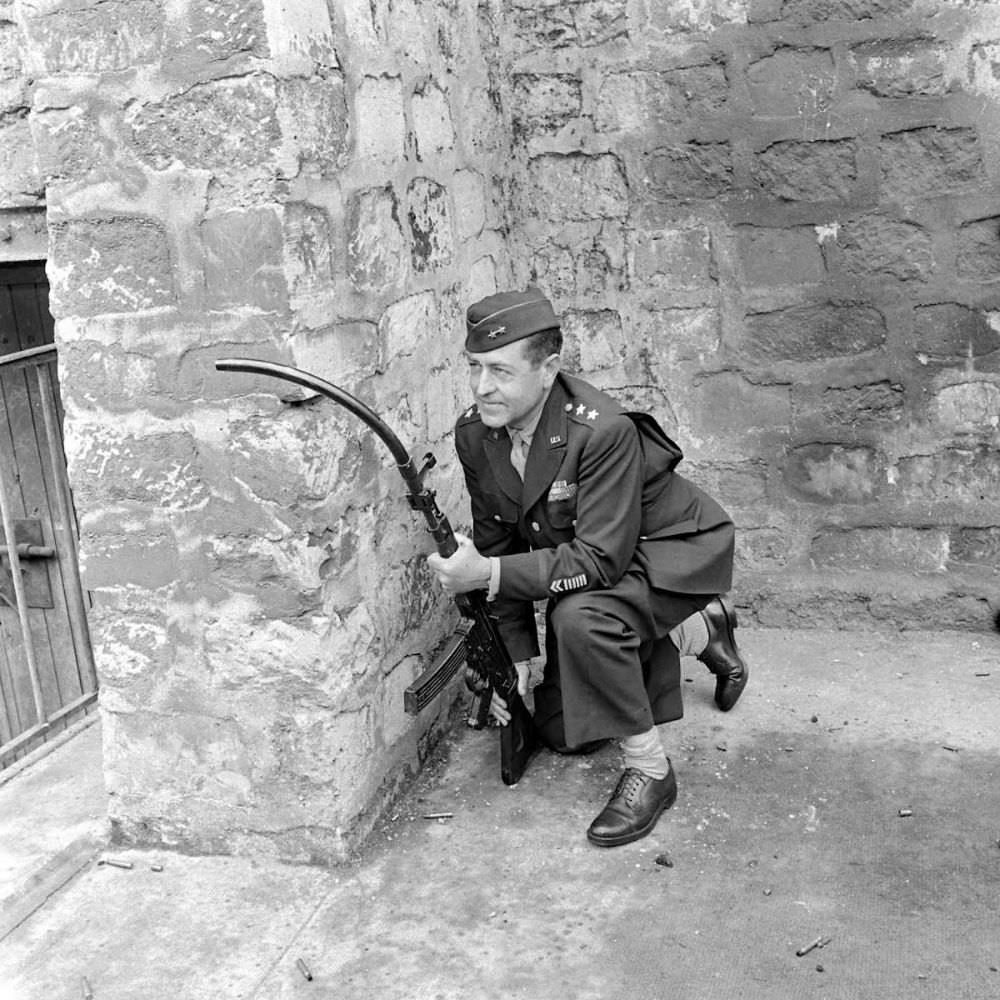
Pressed against a rough stone corner, a uniformed soldier crouches with a rifle that looks almost surreal: its barrel arcs upward like a hook, designed to let a shooter aim around cover without fully exposing himself. The scene feels half battlefield lesson, half engineering demonstration, and it instantly raises the question behind so many WWII inventions—how far could designers push mechanics to solve the brutal geometry of urban fighting?
Known as the Krummlauf, the curved-barrel attachment associated with German small-arms experimentation, the idea promised “bending bullets” by redirecting the muzzle and pairing it with an offset sighting system. In practice, the physics were unforgiving: extreme wear, unreliable accuracy, and shortened service life haunted the concept, even as it remained a fascinating attempt to outsmart walls, trenches, and tight corridors. That tension between bold innovation and harsh reality is written all over the photograph, where the weapon’s odd silhouette is as striking as the soldier’s careful posture.
For readers drawn to WWII technology, rare firearms prototypes, and the strange corners of military invention, this post explores why the Krummlauf existed, what problem it tried to solve, and why it never became more than an experiment. The photo serves as a vivid entry point into a world where engineers chased any advantage—sometimes with solutions that looked like science fiction, yet were born from immediate, practical fear. If you’re researching curved guns, corner-shot concepts, or wartime improvisation, this astonishing tale belongs on your timeline of military history.