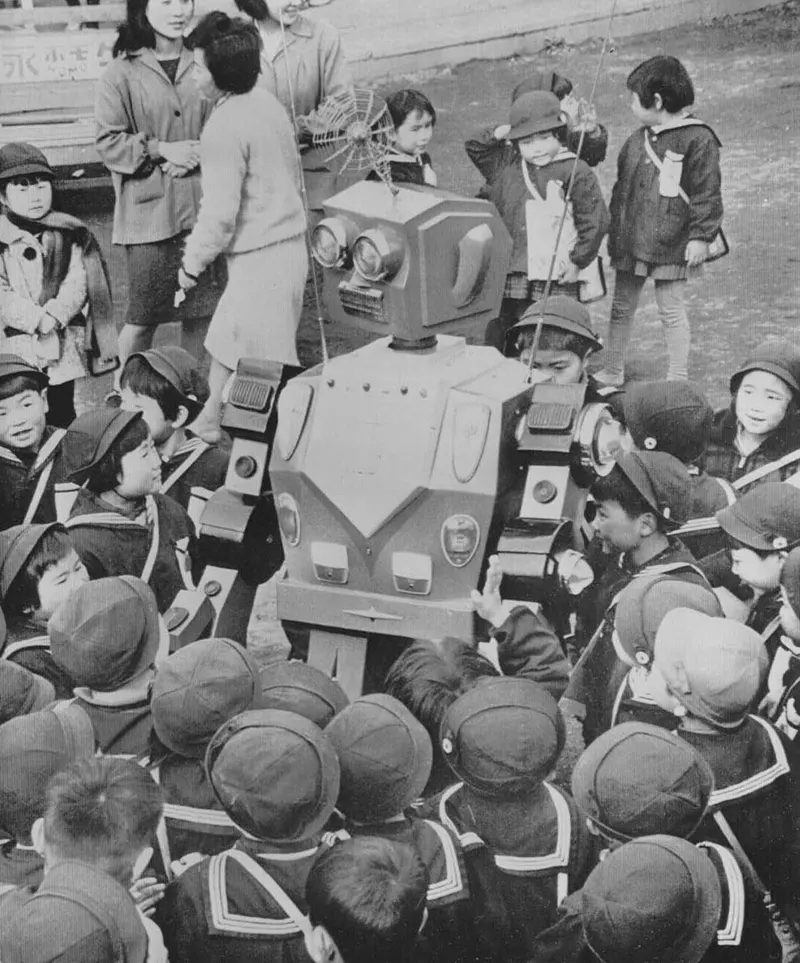
In 1964, the Goro Robot stands at child height yet commands the whole scene, boxed shoulders and a square torso topped by a head that resembles a compact television set. A thin antenna and a wire-like “crown” hint at radio dreams and home electronics, while its large round eyes and simple grille mouth give it a friendly, toy-like face. The design feels proudly mechanical—panels, bolts, and straight edges—made to look modern in an era when “robot” meant the future was already arriving.
Around it, a dense ring of schoolchildren in matching caps and uniforms leans in close, smiling, pointing, and craning for a better look. Their expressions do as much storytelling as the machine itself: curiosity, delight, and the irresistible urge to test whether it moves, talks, or responds. Adults hover at the edges, suggesting a public demonstration or school event where invention becomes spectacle and learning happens through wonder.
For readers interested in mid-century technology history, this photo offers a vivid snapshot of early robotics culture—part engineering experiment, part community entertainment. The Goro Robot captures how 1960s optimism shaped the look and purpose of machines, especially those presented to children as symbols of progress. As a WordPress feature on inventions, it’s a reminder that the history of robots isn’t only factory automation; it’s also the crowds, the classroom excitement, and the imagination that surrounded every new metallic marvel.