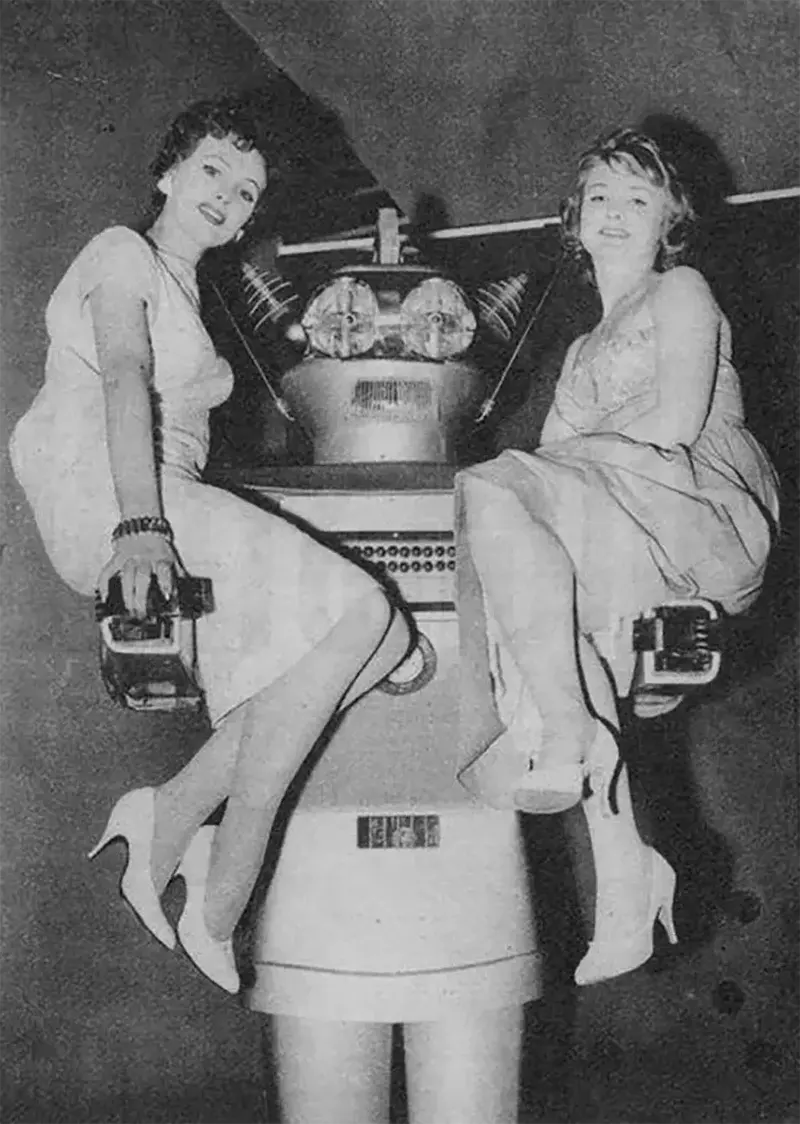
Straddling the line between showroom spectacle and serious engineering, “Gygan, 1957” introduces a bulbous, waist-high machine with a wide metal body, a perforated grille, and a head crowned by twin circular lenses and coiled elements like antennae. Two women in mid-century dresses and heels perch on small side platforms, their poses suggesting the photo was staged to emphasize the device’s scale and futuristic styling. The overall look feels unmistakably 1950s: polished surfaces, playful symmetry, and the promise that technology was about to become a friendly household presence.
At the center, the machine reads like an early robot or automated service unit—part appliance, part prop—designed to be photographed as much as to function. Those glassy “eyes” and spring-like attachments hint at sensors, lights, or demonstration components, while the sturdy pedestal and broad base suggest it was meant to stand in a public setting without tipping. Even without a labeled location, the scene evokes trade fairs, invention expos, and the era’s fascination with pushing buttons and letting modern gadgets do the work.
Behind the charm of this historical photo lies a revealing snapshot of how innovation was marketed in the 1950s: technology presented as sleek, approachable, and exciting, often framed as entertainment as well as progress. The title’s single word, “Gygan,” adds a layer of mystery—more brand name than description—inviting questions about what the machine was built to do and who imagined its future. For readers drawn to retro robotics, vintage inventions, and mid-century design, this image is a compact time capsule of optimism rendered in metal and flashbulb glare.