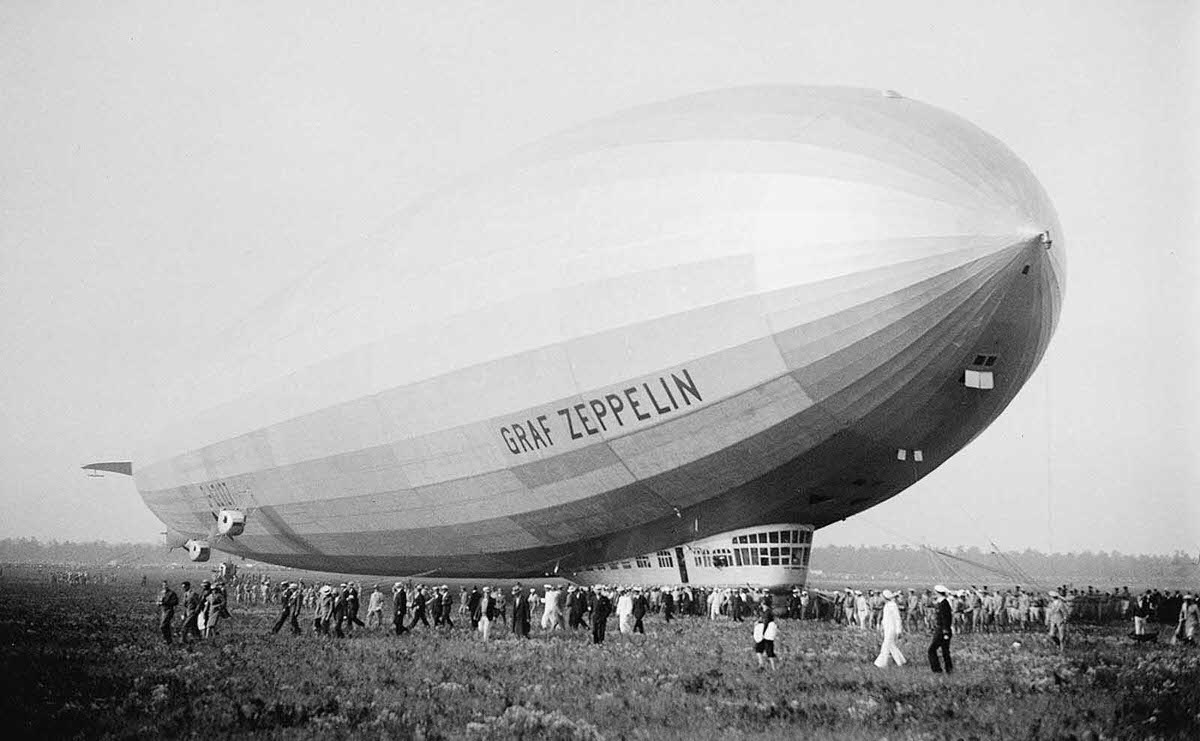
Towering over the open field at Lakehurst, New Jersey, the Graf Zeppelin dominates the frame with its vast, ribbed envelope and bold lettering, making scale the story before anything else. A crowd gathers beneath the airship’s shadow, their small figures emphasizing just how extraordinary this machine looked to onlookers in 1929. Even at rest, the dirigible seems poised for motion, its streamlined form hinting at an era when the future felt light enough to float.
Near the lower edge, the passenger gondola and the airship’s hardware bring the marvel down to human level, where uniforms, hats, and summer clothing mingle in a busy scene of spectators and crew. The ground crew’s proximity suggests a moment of handling or preparation, the kind of careful work required to manage a giant airship safely. Details like the engines and the layered fabric panels make the photograph a rich snapshot of early aviation technology and design.
August 29, 1929, places this visit in a period of intense public fascination with long-distance flight, when German dirigibles symbolized modern engineering and international travel. Lakehurst would become a familiar name in airship history, and images like this help explain why—these arrivals were public events as much as transportation milestones. For readers interested in inventions, vintage aviation, and the Graf Zeppelin’s place in the story of airships, this photo offers a vivid, grounded view of a floating titan meeting the American landscape.