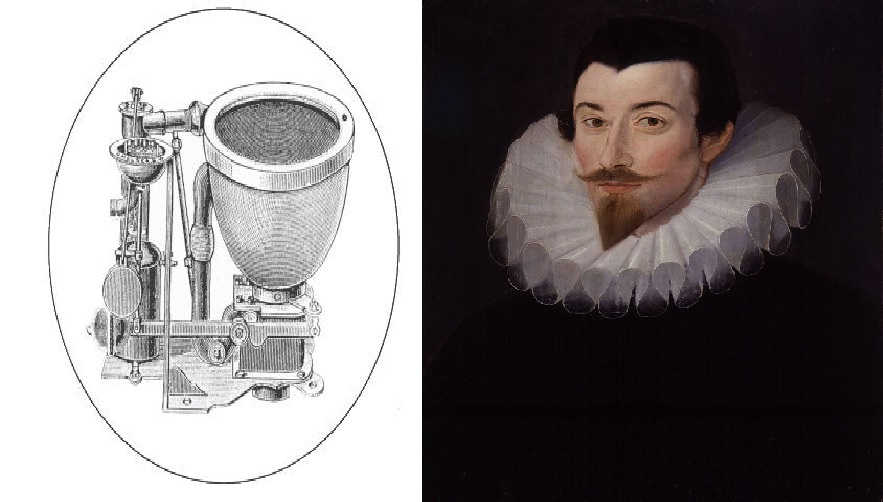
Few household conveniences feel as quietly revolutionary as the flush toilet, and John Harington’s 1596 design reminds us that even the most ordinary routines have an inventive backstory. The post pairs a meticulous technical drawing—full of valves, pipes, and a lidded basin—with a formal portrait that evokes the courtly world in which such ideas could circulate. Together, they frame sanitation not as a modern footnote, but as an early engineering problem tackled with ambition and wit.
On the left, the diagram reads like a Renaissance blueprint: a water-fed system meant to send waste away with a controlled rush, hinting at the mechanics behind what later generations would take for granted. Details such as the elevated cistern and the structured housing suggest a device intended to be both functional and presentable, suitable for an era when “new” technology often had to earn its place through craftsmanship. It’s an artifact of early plumbing history that bridges practical necessity and experimental design.
Across from it, the portrait’s crisp ruff and composed gaze serve as a reminder that inventions are made by people embedded in specific social worlds—where novelty could be celebrated, mocked, or politicized. For readers interested in the history of toilets, early modern inventions, or the evolution of indoor sanitation, this image offers a compelling entry point. Harington’s flush toilet stands here as an emblem of how engineering ideas travel forward, reshaping everyday life long after their first introduction.