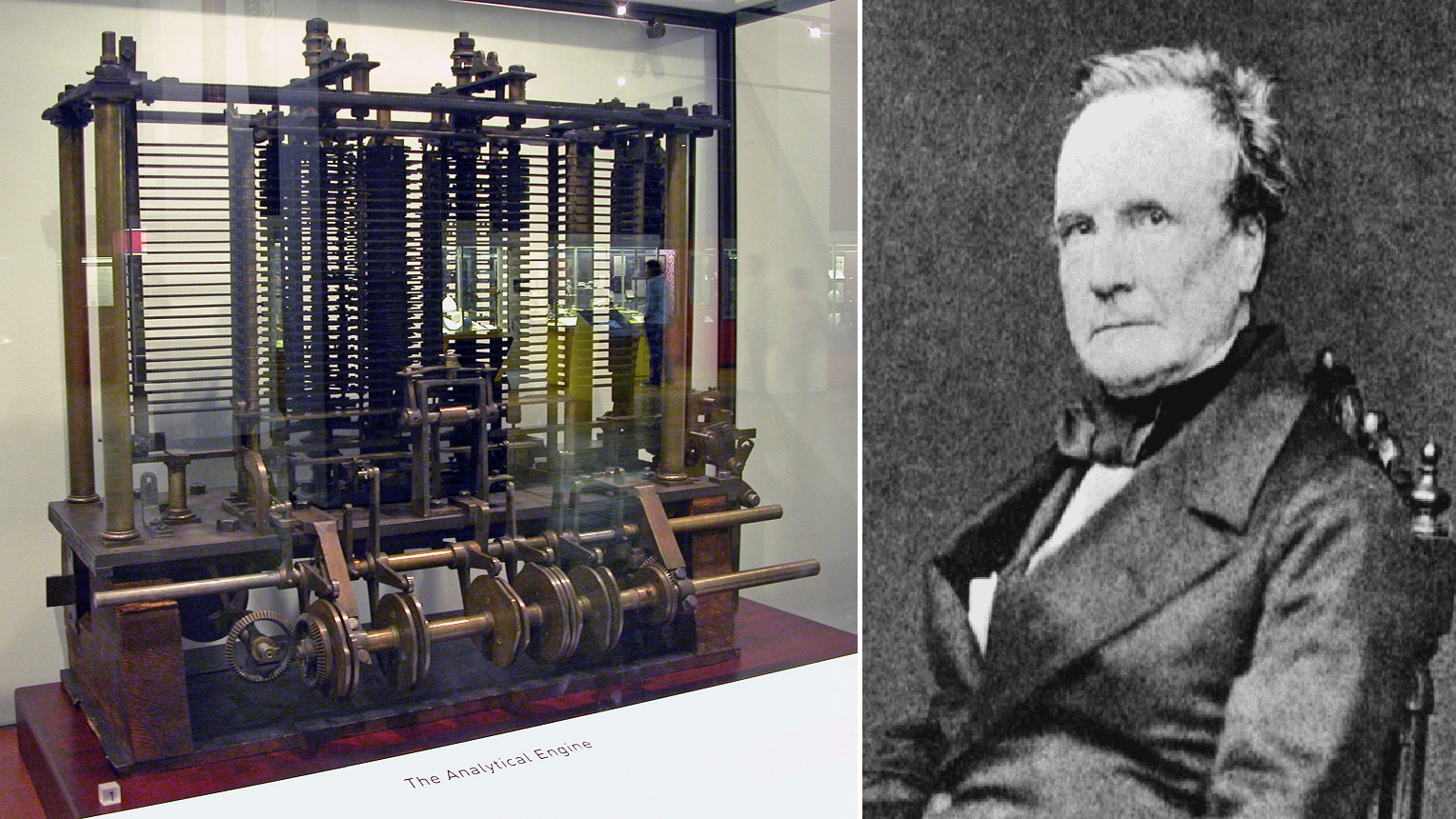
Steel columns, stacked gear trains, and long vertical frames form the unmistakable silhouette of the Analytical Engine, the ambitious 1830s computing design associated with Charles Babbage. Seen behind protective glass like a prized industrial relic, the machine’s dense forest of shafts and numbered-looking assemblies hints at how calculation was once imagined as a choreography of metal parts rather than invisible code. Even without motion, the hardware suggests a device built to store and manipulate quantities with mechanical certainty.
Alongside the engine appears a period portrait of Babbage, a sober reminder that inventions begin as personal obsessions before they become public milestones. The pairing invites readers to connect the human mind to the intricate apparatus: a 19th-century inventor looking out from the past, and a prototype-like structure that embodies his vision of a general-purpose calculating machine. For anyone searching the history of computers, early computing, or Victorian-era innovation, it’s a striking visual bridge between theory and engineering.
What makes this image resonate is the contrast between the clean museum presentation and the sheer complexity of the mechanism itself, which feels closer to a factory’s heart than to the sleek devices we now call computers. The Analytical Engine’s layered components evoke the foundational ideas of modern computation—separating operations, controlling sequences, and producing repeatable results—expressed through brass, iron, and patience. As a WordPress feature on inventions, it offers a compelling, SEO-friendly glimpse into the origins of computer science before electricity ever entered the story.