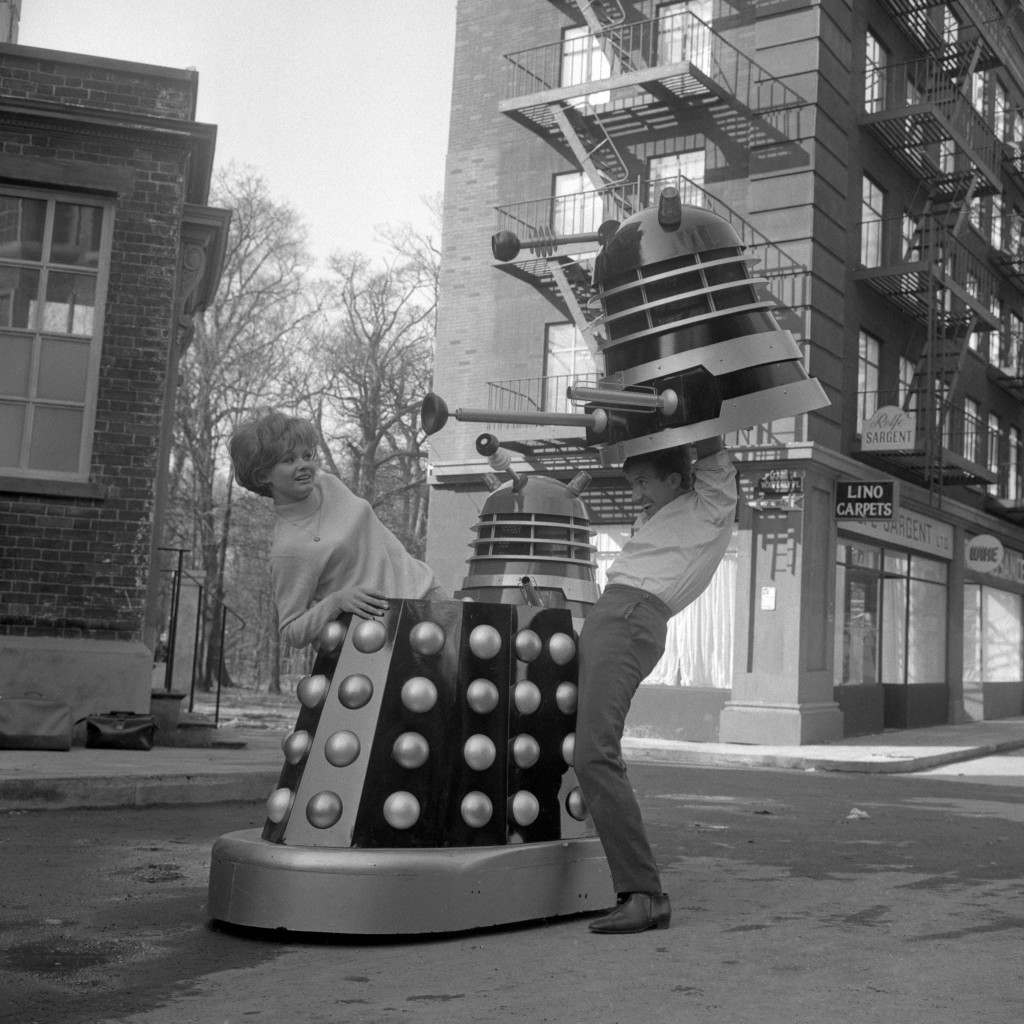
On a quiet city street framed by brick façades and zigzagging fire escapes, two people clown around with a Dalek prop, turning a supposed engine of terror into something oddly playful. The familiar dome, eyestalk, and studded skirt read instantly as Doctor Who, even in a candid moment that feels closer to behind-the-scenes publicity than battlefield menace. Shopfront signage and bare winter trees anchor the scene in everyday life, where science fiction suddenly rolls into the neighborhood.
That contrast helps explain why the Daleks landed so powerfully in the 1960s: they looked like machines, sounded like authority, and yet were simple enough in form to be endlessly staged, photographed, and remembered. Their design is a masterclass in TV invention—bold shapes that pop on camera, practical construction that could survive studio work, and a silhouette so clear it became a visual shorthand for alien threat. Here, stripped of dramatic lighting and special effects, the prop’s physical presence still carries that uncanny weight.
For fans tracing the Daleks’ first appearance and rapid rise as iconic sci-fi villains, images like this offer a valuable glimpse of how pop culture is built in plain sight. The photo suggests the bustling ecosystem around Doctor Who in the 1960s—promotion, performance, and craftsmanship—where a terrifying antagonist could double as a street-level spectacle. It’s a reminder that the Daleks weren’t just monsters on a screen; they were a portable idea, engineered to travel, to be seen, and to stick in the public imagination.