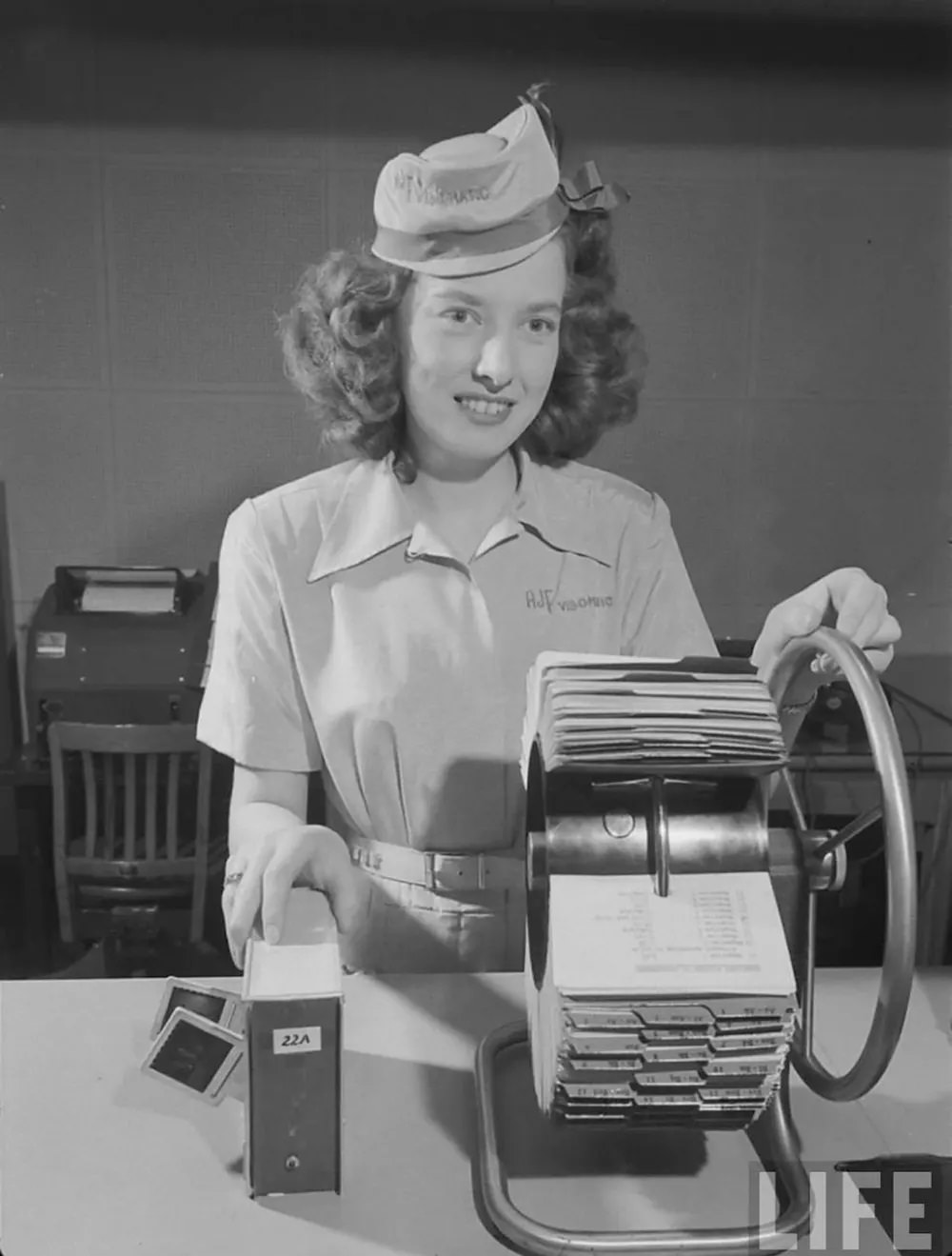
Long before shopping carts and checkout pages lived in a browser, companies experimented with “online” retail using the tools of their day—screens, catalogs, and communications systems that could transmit an order without a customer ever touching a shelf. The photo hints at that early ambition: a neatly uniformed worker smiles beside a bulky, rotary-style selector loaded with labeled cards, the kind of apparatus designed to turn product choices into something a back office could process. It’s a reminder that the desire for convenient, at-home purchasing didn’t begin with the internet; it simply waited for the networks to catch up.
In the foreground, the device reads like a mechanical menu, flipping through entries as if it were a physical version of scrolling a product list. A small file box marked “22A” sits nearby, suggesting an organized system of codes—early retail data management in paper and plastic rather than pixels. Even the plain office setting, with sturdy furniture and equipment in the background, reinforces how much “e-commerce” once depended on clerks, filing systems, and specialized machines to bridge the gap between customer selection and warehouse fulfillment.
Curiosity comes naturally when looking at inventions like this: how did shoppers view the offerings, how were choices recorded, and how quickly could items be shipped once the request arrived? The title’s promise—customers ordered from screens and the company shipped—fits neatly into the larger story of retail innovation, where mail-order habits evolved into remote ordering and, eventually, modern digital commerce. For anyone interested in the history of technology, early online shopping, or the origins of e-commerce, this image offers a fascinating snapshot of a future being assembled one mechanical step at a time.