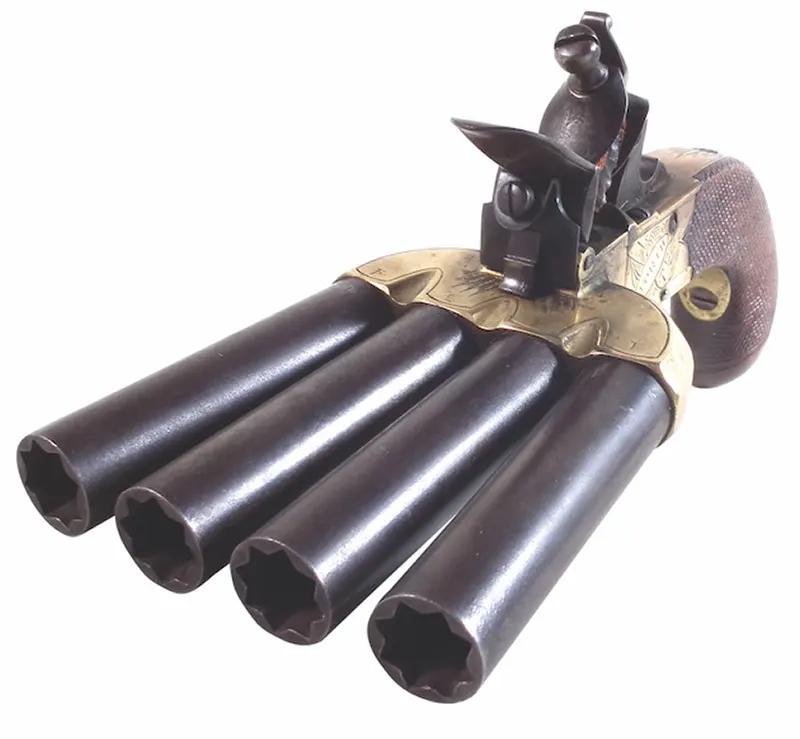
Splayed like a waterfowl’s toes, the duck foot pistol is one of the 18th century’s most striking firearm inventions, designed to throw multiple shots at once. The photo highlights its distinctive cluster of barrels fanning outward from a single grip, with dark metal tubes contrasted by a brass-toned plate near the breech. Even at a glance, the unusual geometry signals a weapon built for a specific problem: dispersing fire across a wider area than a conventional single-barrel pistol could manage.
Look closely and the practical craftsmanship comes through in the details—the shared firing mechanism, the compact lockwork, and the tight packing of the barrels that gives the piece its unmistakable silhouette. The wooden grip, worn smooth in places, hints at handling and age, while the multi-barrel arrangement suggests an intention to deter or control more than one threat at close range. In an era when reloads were slow and encounters could be sudden, engineering solutions like this were as much about psychology as ballistics.
For collectors, historians, and anyone interested in antique weapons, the duck foot pistol sits at the crossroads of ingenuity and anxiety in early modern life. It reflects a time when firearm design experimented boldly with form—sometimes prioritizing immediate impact over precision—before later developments pushed handguns toward standardized, repeating systems. As a historical artifact, it’s an unforgettable reminder that the 18th century was not only an age of exploration and industry, but also of inventive, sometimes unsettling, solutions to everyday danger.