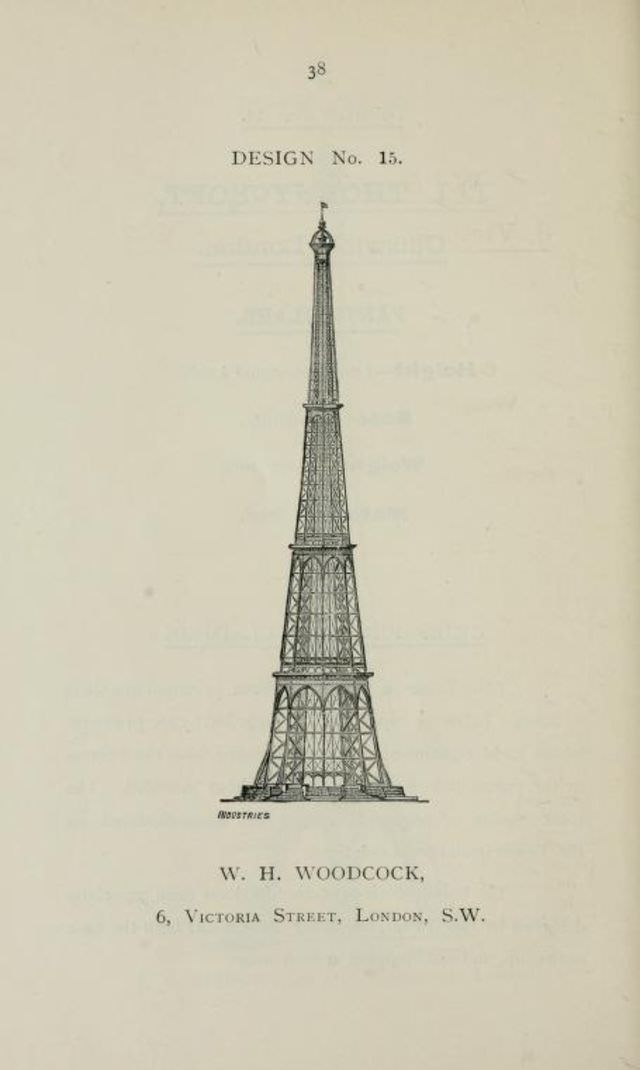
Numbered “38” at the top and labeled “DESIGN No. 15.”, this period page reads like a slice of Victorian ambition on paper: a proposed Great Tower for London rendered as a tall, tapering iron lattice with stacked stages, arched bracing, and a small flag crowning the summit. The draughtsmanship is spare but confident, giving the structure a sense of engineered lightness while still anchoring it with a broad, grounded base. Beneath the drawing, the designer’s credit line—“W. H. Woodcock, 6, Victoria Street, London, S.W.”—adds a satisfying archival specificity, as if you’re peering into the very catalog circulated to judges and the curious public.
In an era hungry for record-breaking heights and modern spectacle, competitions like the 1890 “Great Tower” proposals invited inventors, architects, and engineers to imagine what London’s skyline could become. The design here nods to the language of late-19th-century iron construction: openwork trusses, repetitive geometric rhythms, and tiered platforms that suggest viewing galleries or functional landings. Even without a built outcome, such drawings reveal the imaginative pressure of the time—how technology, tourism, and civic pride could all be folded into a single vertical monument.
For readers searching for historic London inventions, Victorian engineering concepts, or the unrealized Great Tower competition, this document is a vivid reminder that cities are shaped not only by what gets built, but also by what nearly did. The clean typography, the formal numbering, and the centered elevation turn the page into both an advertisement and a technical promise. Consider it one entry among “50+ competitive designs,” each one a different answer to the same question: how high could London dare to dream in 1890?