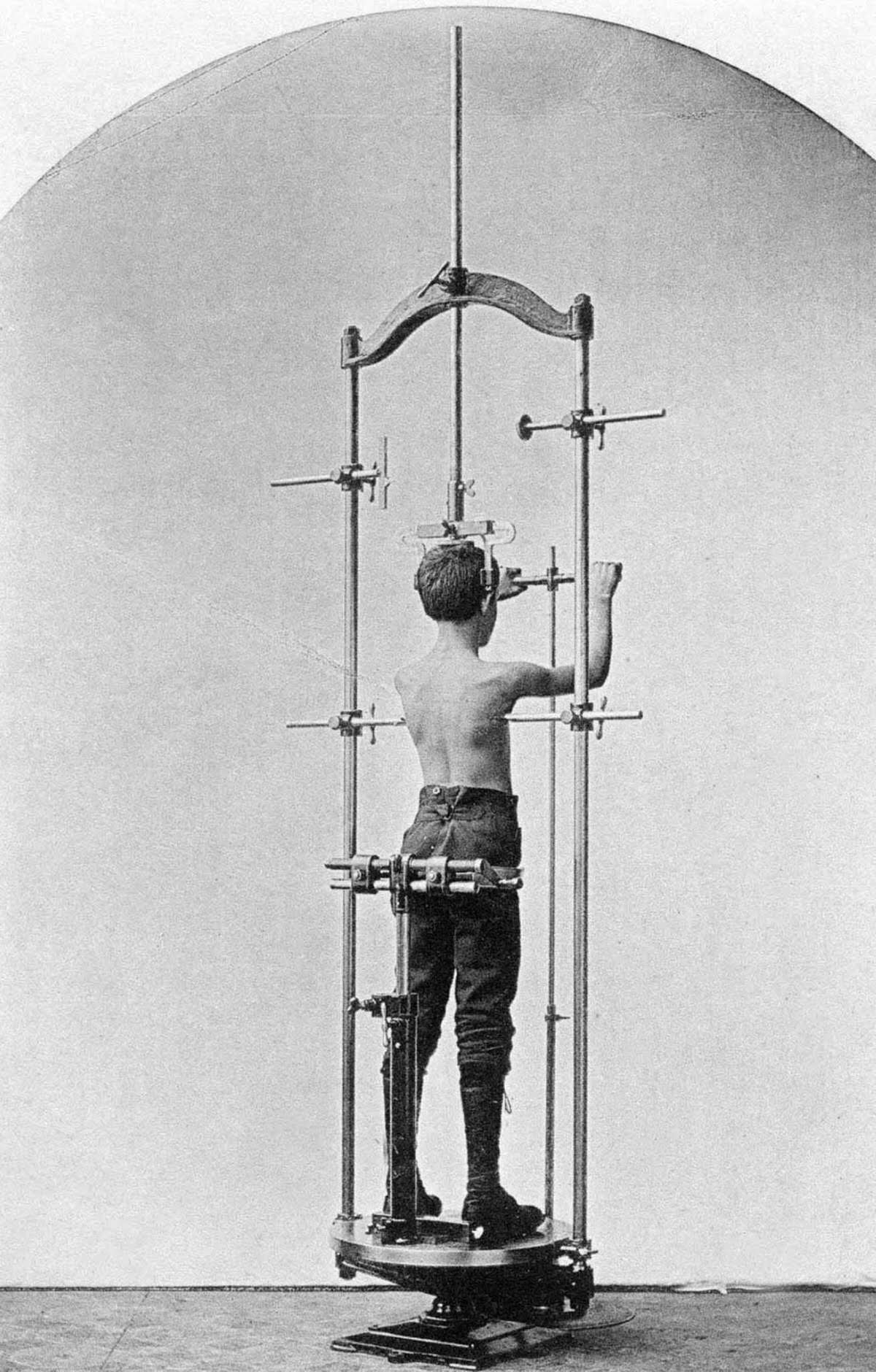
A young subject stands barefooted on a circular platform, his back turned to the camera, framed by a tall lattice of rods, clamps, and sliding crossbars. The contraption’s rigid uprights rise above his head like the scaffold of a surveyor’s rig, while adjustable arms hover near shoulder, waist, and hip height as if ready to “read” the body in millimeters. Even in stillness, the apparatus suggests motion—parts designed to glide, lock, and repeat measurements until the torso’s outline becomes data.
What makes the scene so striking is the tension between vulnerability and precision: skin exposed, posture held, and the spine implicitly judged by straight lines of metal. Devices like this trunk-measuring apparatus belonged to an age that trusted instruments to translate anatomy into objective records, whether for medical assessment, posture correction, or the broader project of cataloging human form. The title’s invitation to map the contours of your torso and the bends of your spine feels literal here, with every bar positioned like a coordinate on a living chart.
Inventions often promise improvement, and this photograph carries that optimism alongside a hint of unease—an intimate body turned into a diagram through mechanical touchpoints. For readers interested in the history of medical technology, biomechanics, and early measurement culture, this image offers a vivid glimpse of how engineers and clinicians tried to make the invisible visible. It’s a reminder that long before digital scans and 3D modeling, the quest to quantify posture and proportion relied on towering frameworks of steel, patience, and the human willingness to stand perfectly still.