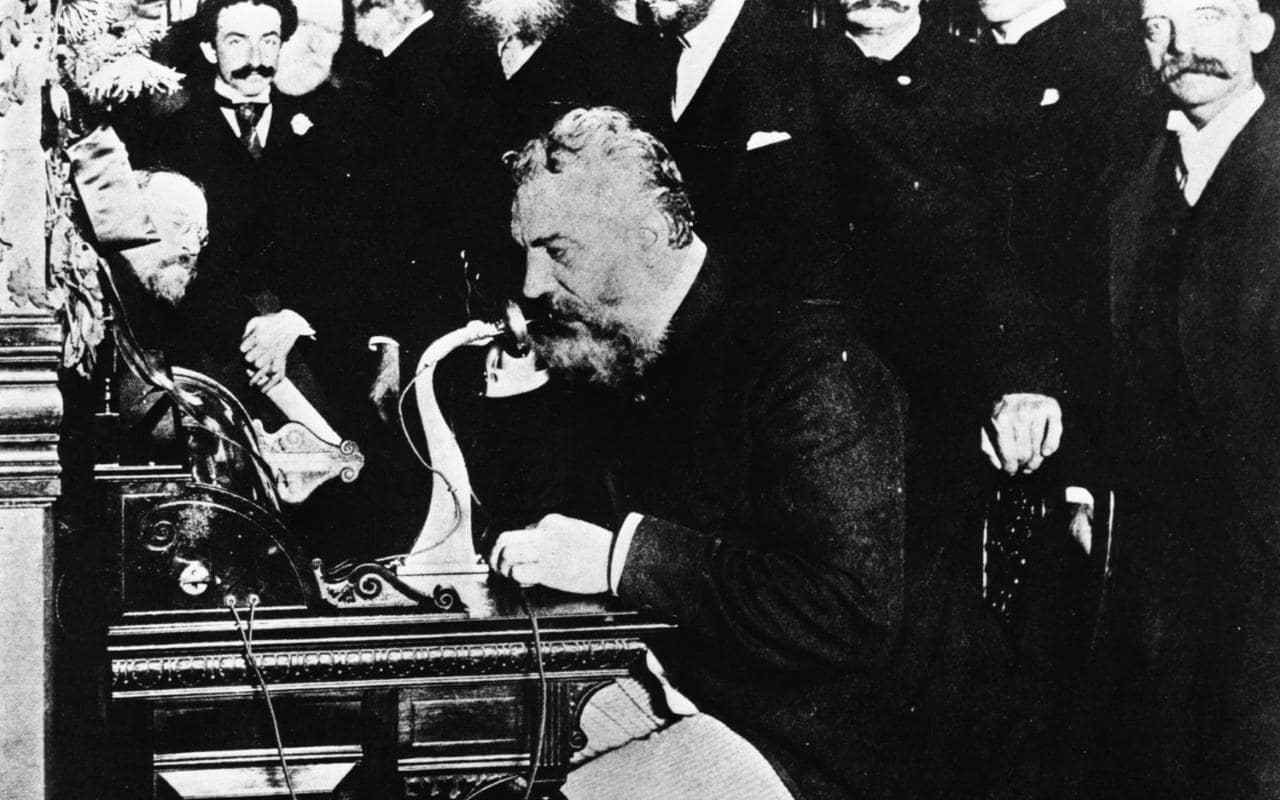
A crowded room leans in as Alexander Graham Bell bends toward an early telephone set, his posture intent and almost intimate with the machine. The device itself looks more like a piece of ornate laboratory furniture than a household tool—curved metalwork, a small mouthpiece, and visible wiring arranged on a polished table. Around him, men in dark suits and stern expressions form a tight semicircle, their attention fixed on the fragile-looking apparatus and the promise it carries.
Bell’s 1876 telephone belonged to a moment when “talking at a distance” still sounded like showmanship, and demonstrations mattered as much as diagrams. In the scene, the audience’s proximity suggests both skepticism and fascination: this was technology that had to be witnessed to be believed. The photo emphasizes the physicality of early communication inventions—sound translated into vibration, vibration into signal, and signal back into a human voice—long before sleek handsets made the process invisible.
For readers exploring the history of inventions, this image offers a compelling window into the birth of modern telecommunications. It hints at the transition from telegraph-era pulses to voice transmission, a shift that would reshape business, news, and everyday life. As a WordPress feature, “Telephone (1876) by Alexander Graham Bell” pairs well with topics like early electrical engineering, 19th-century innovation, and the origins of the phone that would eventually connect the world.