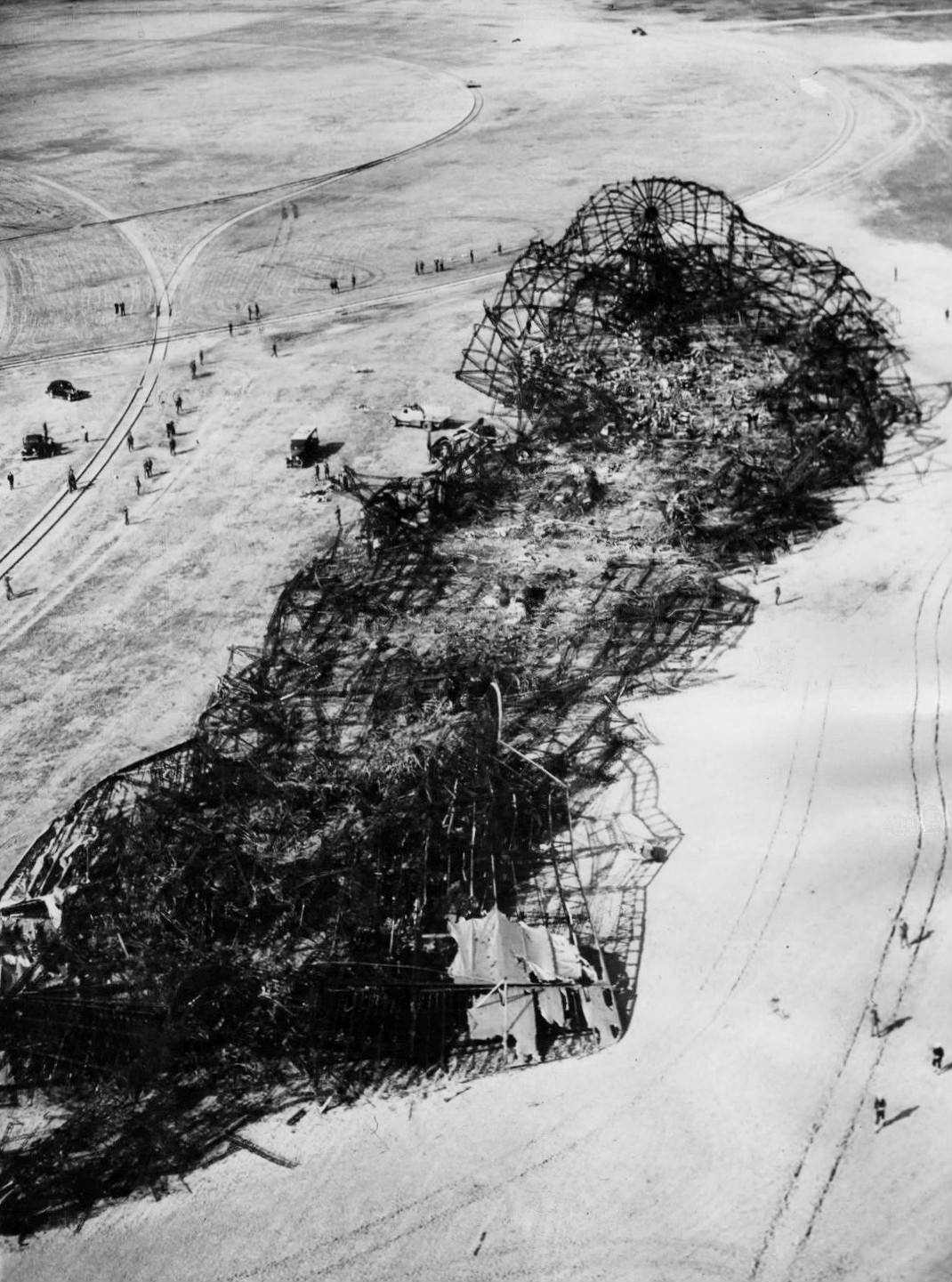
Morning light falls on a long, skeletal ruin: the Hindenburg’s framework lies flattened across an open field, its once-smooth skin gone and its ribs twisted into a dark lattice. From this elevated viewpoint, the wreckage reads like a broken backbone, stretching from the foreground into the distance. The stark contrast between the pale ground and the charred metal underscores how quickly a celebrated feat of engineering could be reduced to scrap.
Along the perimeter, tiny human figures and a few vehicles appear as dots and silhouettes, emphasizing the airship’s immense scale even in collapse. Tracks curve through the surrounding expanse, guiding the eye toward the disaster site like improvised pathways for recovery and inspection. Nothing here feels theatrical; instead, the scene carries the quiet, methodical atmosphere of the day after—when smoke has cleared and questions begin.
For readers drawn to aviation history, early air travel, and the story of inventions that promised a new age, this photograph offers a sobering hinge point. The Hindenburg disaster has often been remembered for its fiery immediacy, yet the morning-after wreckage reveals the lasting reality: materials, measurements, and the human effort to make sense of catastrophe. It’s an enduring record of how technological optimism can collide with vulnerability, leaving behind evidence that still invites study and reflection.