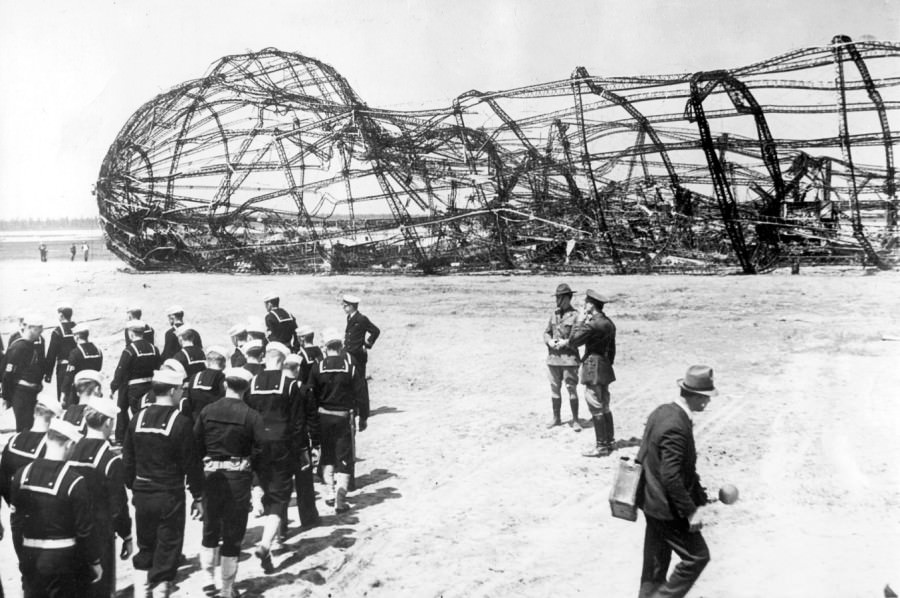
Twisted ribs of aluminum sprawl across an open field where the Hindenburg once floated like a promise of effortless travel. With its skin burned away, the great airship is reduced to a stark framework—an “inert skeleton” that makes the scale of the disaster impossible to ignore. The stark contrast between the vast wreckage and the empty sky turns the scene into a quiet monument to a technology that had seemed unstoppable.
In the foreground, uniformed onlookers and responders gather in clusters, their attention fixed on the collapsed structure. Their presence adds human measure to the catastrophe: small figures pacing beside a giant’s remains, surrounded by scorched debris and bare ground. The photo reads almost like a forensic tableau, inviting the viewer to trace lines of buckled girders and imagine the heat and chaos that moments earlier consumed the craft.
Few images better capture the turning point in aviation history when the age of passenger zeppelins lost its aura of safety and wonder. For readers interested in inventions and the rise—and abrupt fall—of airship travel, this photograph provides a powerful, search-worthy window into the aftermath of the Hindenburg disaster. It’s a reminder that progress can be breathtaking, and brittle, and that sometimes all that survives of a bold idea is the frame that once held it aloft.