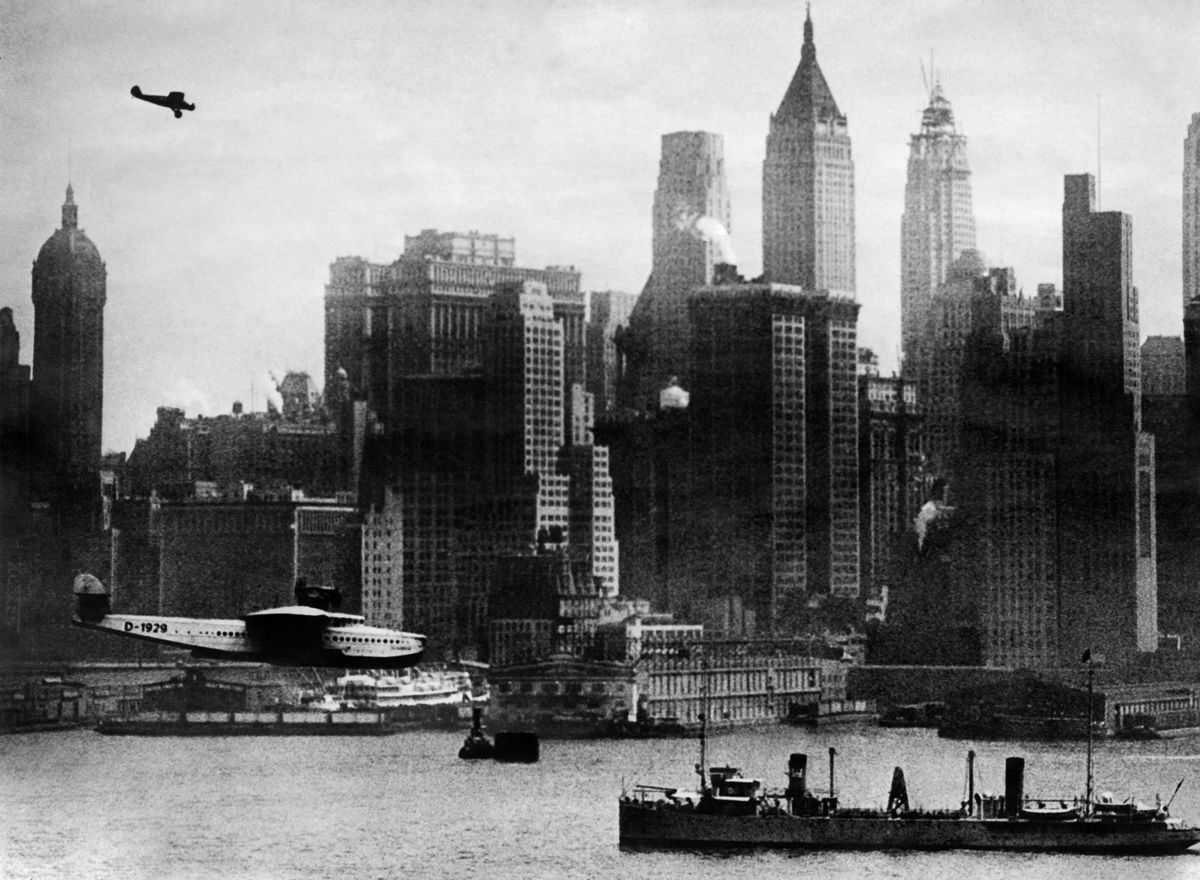
Against a jagged skyline of early-1930s skyscrapers, the Dornier Do-X glides low over the Hudson River, its broad hull and high wingline reading more like a ship than an airplane. A smaller aircraft circles higher above, emphasizing the Do-X’s scale as it comes in to land on the water. The scene is both airy and industrial, with river traffic below and a haze of city smoke and light around the towers.
Built for long-distance ambition, the Do-X belonged to that brief, daring era when aviation’s future seemed to lie with giant flying boats that could use harbors as runways. The Hudson, framed here by dense waterfront buildings and piers, becomes a stage for engineering spectacle—part demonstration, part advertisement for what modern transport might soon achieve. Even without close-up detail, the aircraft’s distinctive silhouette signals an age when designers pushed size and range as measures of progress.
Dated Sept. 1, 1931, this photograph captures more than a landing; it preserves a moment when New York’s riverfront served as a gateway for experimental air travel. For readers interested in inventions and the history of aviation, it’s a vivid reminder that the path to today’s airliners ran through bold prototypes, public flyovers, and waterborne arrivals. The contrast between the monumental cityscape and the low, steady approach of the Do-X makes the image linger like a newsreel still from a world on the edge of the modern.