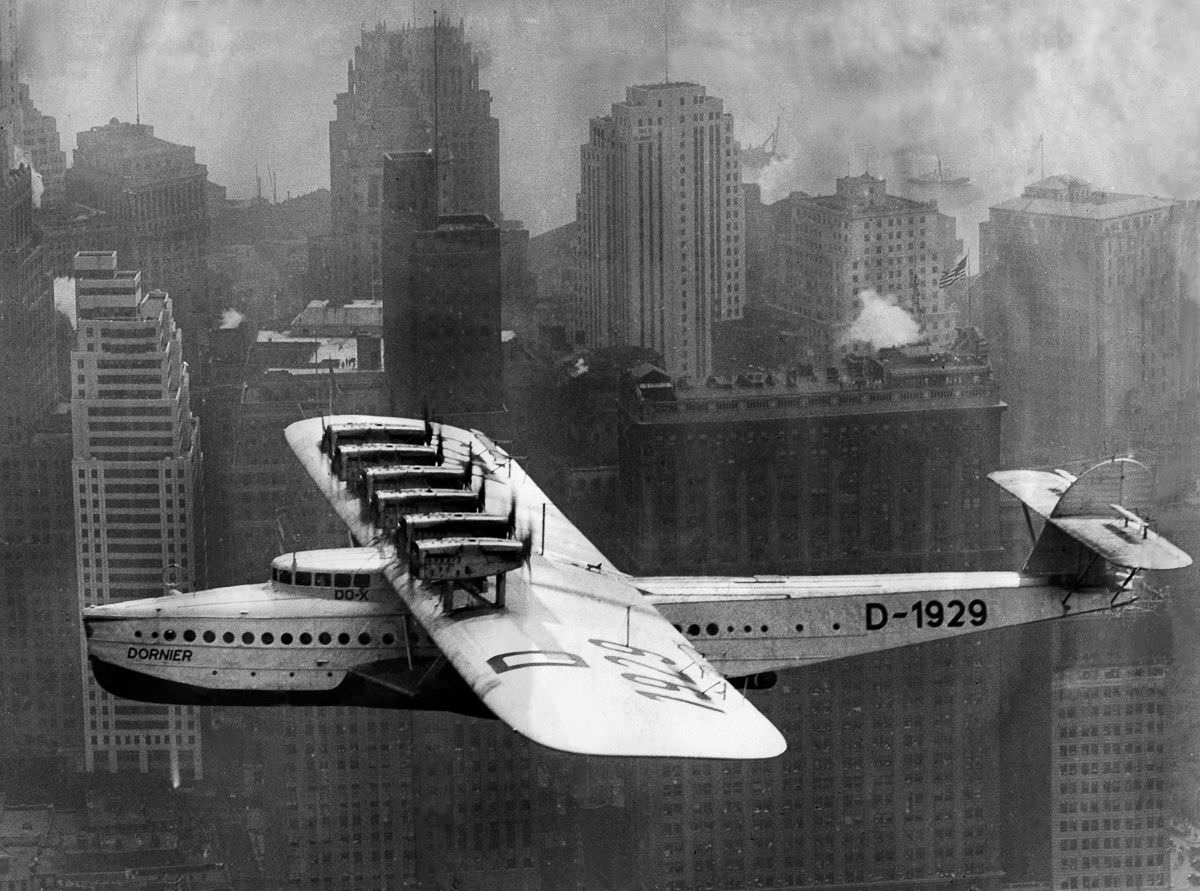
Gliding through a hazy New York City skyline on September 1, 1931, the Dornier Do-X looks less like a conventional airplane and more like an ocean liner that learned to fly. Its broad wings carry a row of engine nacelles, and the boat-shaped fuselage—marked “DORNIER” and “DO-X”—signals its identity as a flying boat built for long journeys and big ideas. Against the vertical geometry of early skyscrapers, the aircraft’s sheer scale becomes the story: a bold experiment passing in front of a city that was itself a monument to ambition.
Details in the frame reward a closer look, from the registration “D-1929” on the tail to the porthole-like windows running along the side, evoking the comfort and spectacle promoters hoped aviation could deliver. The Do-X belonged to an era when engineers chased the promise of transoceanic travel with designs that blended maritime thinking and aeronautical innovation. Even the smoky, layered atmosphere over Manhattan adds to the mood—modern industry below, modern flight above—capturing a moment when progress felt tangible in steel and rivets.
For readers drawn to aviation history, Art Deco New York, or the broader theme of early 20th-century inventions, this photograph offers a vivid intersection of technology and place. The Do-X’s flight past the skyline underscores how public demonstration and media imagery helped shape confidence in air travel long before jetliners made it routine. Seen today, the scene still carries that original sense of wonder: a giant flying boat threading between the symbols of a rising city and a rising age of flight.