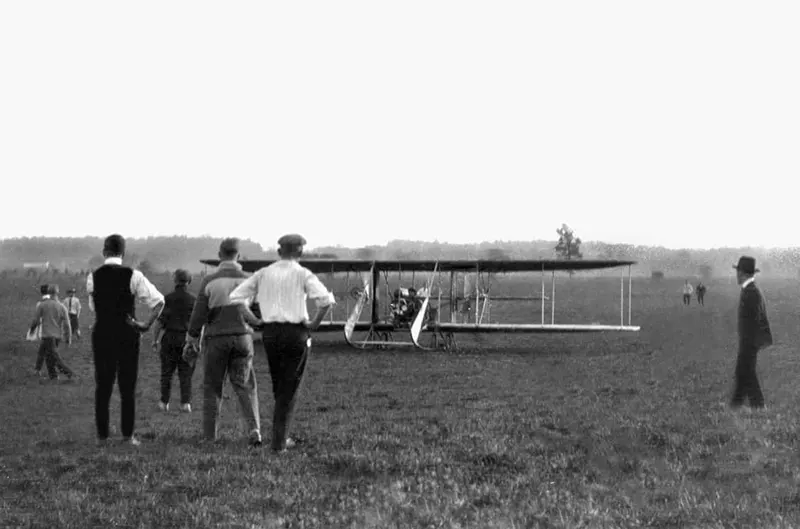
On an open Ohio field in the 1900s, onlookers stand at a cautious distance while an early aircraft rests low on the grass, its broad wings stretched out like a scaffold against the sky. The machine’s exposed framework, thin struts, and spindly landing gear hint at how experimental flight still was, while the gathered crowd—men in hats and work clothes—turns the moment into a community spectacle as much as a technical demonstration.
Aviation in this era often unfolded in pastures and fairgrounds rather than paved runways, and the setting here feels improvisational in the best sense: a wide horizon, a simple flying field, and a handful of people acting as witnesses to a new kind of transportation. There’s a quiet tension in the way bodies are positioned—some hands on hips, others leaning forward—as if everyone is waiting for the machine to prove itself, to lift and hold, if only briefly.
Early aircraft photos like this one offer more than a glimpse of engineering; they capture the social side of invention, when curiosity could pull a town together and the promise of flight still carried an edge of risk. For readers interested in Ohio history, the early 1900s, and the dawn of aviation, this image places you right at the threshold—where a fragile-looking craft and a captivated crowd share the same uncertain, hopeful afternoon.