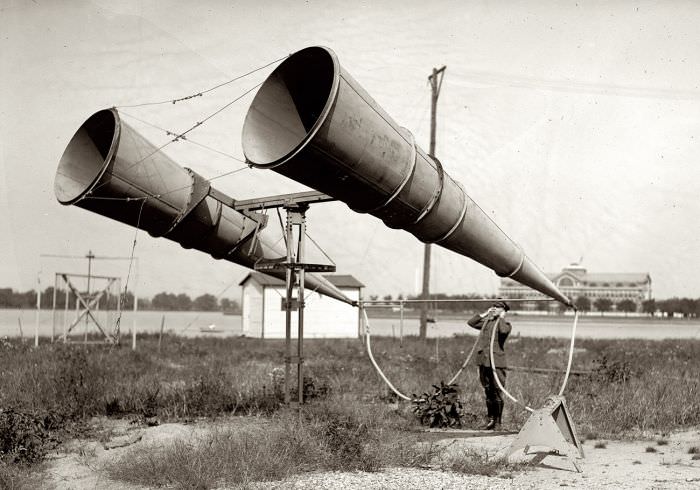
Twin metal horns dominate the foreground at Bolling Field, their wide mouths aimed skyward like oversized megaphones from the early age of aviation. Mounted on sturdy frames and linked by cables, the apparatus looks more industrial than elegant, yet it speaks to the practical experimentation that defined military airfields in the early 1920s. A lone figure stands beside the right-hand horn, emphasizing the surprising scale of the system and hinting at hands-on operation rather than automated convenience.
In 1921, reliable communication and detection were still being worked out on the ground as pilots pushed farther into the air, and devices like this two-horn setup belonged to that transitional world. Whether used to project sound across the field, aid in signaling, or support acoustic listening, the design reflects a period before modern radar and radio networks became standard. The open landscape of the airfield, with its sparse structures and utility poles, underscores how much of aviation infrastructure was being built in real time.
Beyond the equipment, the background places the scene near Fort McNair, where the Army War College rises faintly across the distance, tying technological trial to strategic planning. The contrast is striking: improvised-looking invention in the foreground, institutional authority on the horizon. For readers interested in U.S. military history, early airfield technology, and the inventive culture of the interwar years, this photograph offers a vivid snapshot of problem-solving at the edge of progress.