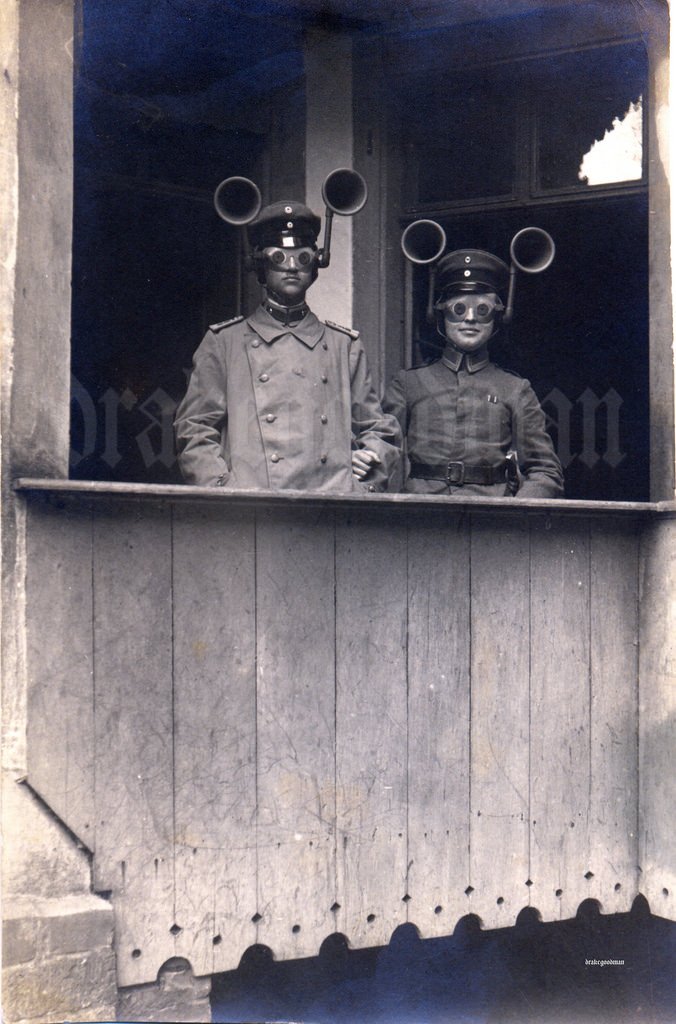
Perched behind a wooden balcony rail, a junior officer and an NCO pose in uniform with a striking piece of field technology strapped to their heads: a portable sound locating apparatus. The paired horn-like receivers and goggle-style eyepieces give them an almost otherworldly silhouette, yet the scene is calm and composed, suggesting a moment of demonstration rather than immediate combat. Their insignia and dress point to a German Feldartillerie unit, though the regiment itself remains unidentified.
By 1917, the Western Front had become a contest not only of guns and men but of measurement, detection, and calculation—an “inventions” war in the most literal sense. Sound ranging and acoustic direction-finding offered a way to detect enemy artillery by listening for the report of a gun and comparing the direction and timing of the sound, feeding vital information back to batteries and staff. Devices like the one shown here sit at the crossroads of improvisation and emerging military science, bridging human senses and mechanical amplification.
Details in the photograph reward a closer look: the flared tubes angled outward, the snug headgear, and the deliberate stance of two soldiers presenting their equipment to the camera. It’s an evocative World War I image of early battlefield surveillance, where listening became a weapon and technology crept into every corner of the front. For readers interested in WWI artillery, sound locating, and the evolution of military instruments, this portrait offers a memorable glimpse into how armies tried to find the unseen in the chaos of 1917.