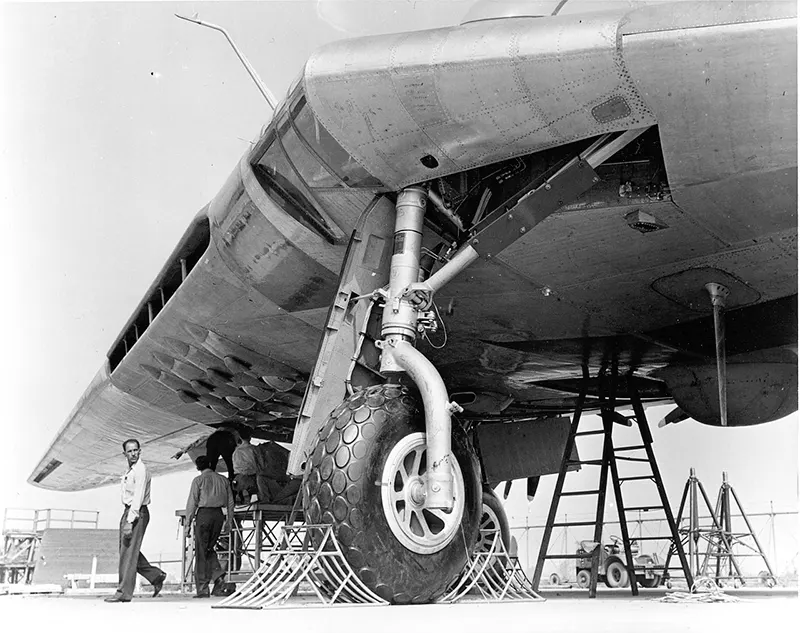
Dominating the frame with its broad, tailless planform, the Northrop XB-35 flying wing sits on the ground like a single piece of engineered landscape. The camera’s low angle emphasizes the aircraft’s immense underside and the smooth sweep of the wing, where panel lines, access hatches, and subtle curvature hint at the careful aerodynamics behind the design. Nearby figures appear small by comparison, giving an immediate sense of scale that words alone can’t match.
Attention naturally falls to the exposed landing gear: a stout strut, heavy wheel, and the intricate plumbing and fittings that kept this heavy bomber prototype practical on the runway. Under the wing, ladder-like supports and ground equipment suggest inspection or maintenance work in progress, the everyday labor that accompanied ambitious aviation experiments. The texture of metal skin and the utilitarian geometry of the wheel assembly make the “inventions” theme tangible—innovation rendered in rivets, braces, and hydraulics.
Northrop’s XB-35 remains one of the most compelling detours in military aviation history, an attempt to trade the traditional fuselage-and-tail silhouette for the promise of a flying wing’s efficiency. Even without the drama of flight, this historical photo conveys the boldness of the concept: a bomber-sized aircraft built around a single aerodynamic idea. For readers interested in experimental aircraft, heavy bomber development, and the roots of later flying-wing designs, it’s a vivid look at how radical ideas were tested on the tarmac before they ever proved themselves in the sky.