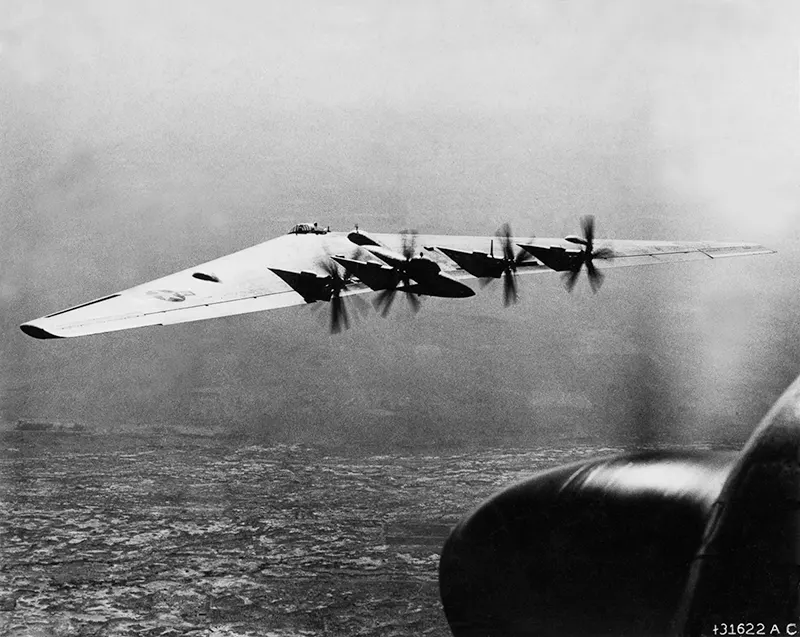
A massive flying wing glides above a textured patchwork of ground far below, its sleek profile broken only by a row of spinning propellers that blur into dark halos. The XB-35’s unusual silhouette—more manta ray than conventional bomber—turns the sky into a proving ground for radical aeronautical thinking, where lift, stability, and efficiency were pursued in a single sweeping shape.
Look closely and the design’s ambitions become clear: a broad, continuous wing built to promise long-range performance, reduced drag, and formidable payload potential without the familiar fuselage-and-tail arrangement. That promise demanded inventions and engineering compromises—complex propeller systems, intricate internal structure, and novel control solutions—making the aircraft as much a laboratory in the air as a weapon concept on paper.
Even in a still image, the XB-35 carries a certain mystique, embodying the era’s confidence that bold geometry and relentless experimentation could reshape strategic aviation. For readers searching the history of the XB-35 bomber aircraft inventions, this photograph offers a compelling entry point: a reminder that groundbreaking aerospace projects often live in the space between mastery and uncertainty, where every flight tests not just an airplane, but an idea.