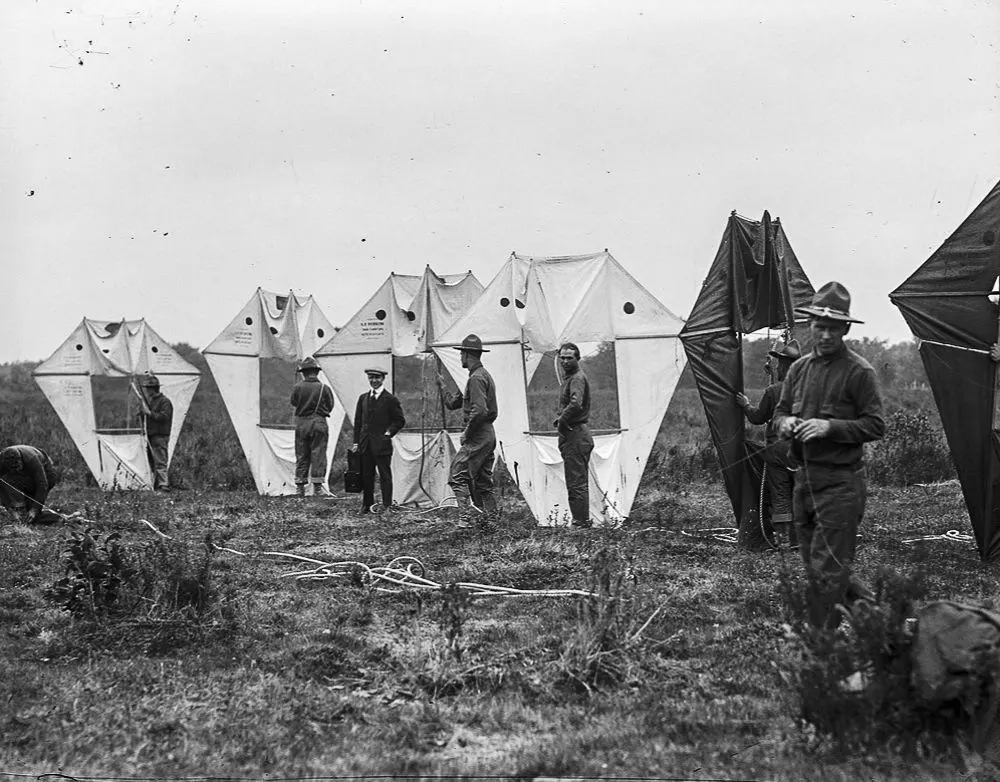
Across a rough field, a row of boxy, fabric-covered kites stands like a temporary wall—rigid frames, taut panels, and circular cutouts hinting at careful engineering rather than play. Men in work clothes and brimmed hats move among coils of rope and stakes, preparing the line work that made these “man-lifting” systems possible. The scene feels half workshop, half field trial, capturing the moment when wind, wood, and canvas were being pressed into service as serious technology.
Long before airplanes and drones became the default tools of aerial reconnaissance, military and scientific experimenters looked upward for a cheaper, simpler way to get eyes over the horizon. Man-lifting kites promised exactly that: lift a human observer using stable multi-cell designs, then keep them aloft on a tether while teams on the ground managed tension and direction. The photo’s clustered kites and abundant rigging quietly reveal the real story—this wasn’t a single kite trick, but an organized system built to tame gusts, carry weight, and hold steady in the sky.
For readers drawn to forgotten inventions, the history of man-lifting kites is a fascinating bridge between ballooning and powered flight, where ingenuity had to compensate for limited engines and evolving battlefield needs. Details like the repeating kite shapes, the careful spacing, and the practical gear underfoot evoke an era of trial-and-error experimentation with aerial observation technology. It’s a reminder that the path to modern surveillance and reconnaissance didn’t start with electronics—it started with wind, rope, and a willingness to be lifted into the air.