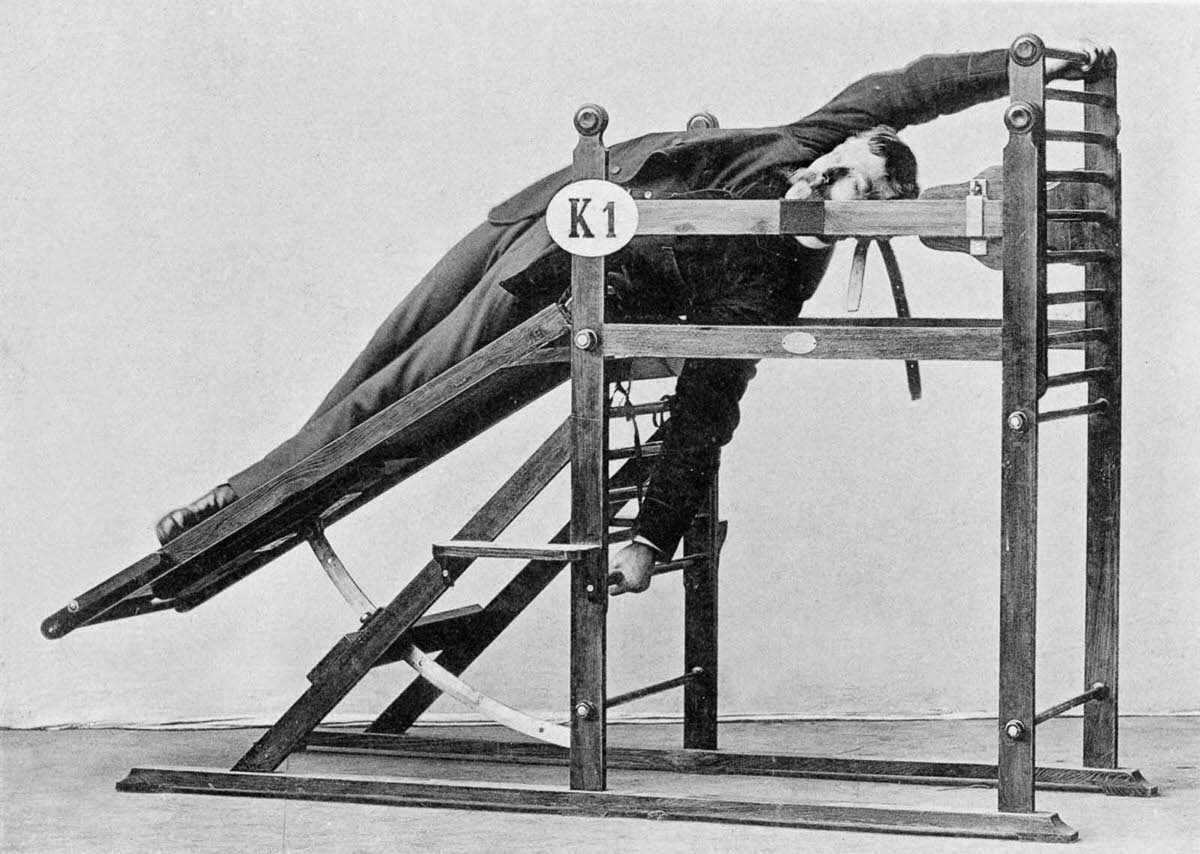
Balanced at an angle on a sturdy wooden frame, a suited demonstrator leans into an apparatus that looks equal parts gym equipment and workshop prototype. The body is held diagonally, with the torso supported while one arm reaches up toward a ladder-like end piece, turning a simple stretch into a dramatic pose. Even the small “K1” marker on the side hints at the experimental, cataloged feel of early physical-culture inventions.
What makes this diagonal-suspension device so fascinating is its promise of a “thorough stretching” by using gravity as the main resistance. Rather than relying on weights, it positions the spine and ribs in a long line, encouraging the sides of the body—those often-neglected obliques and intercostal muscles—to open up as the user braces and reaches. The mechanical adjustability implied by the pivots, slats, and stepped supports suggests an inventor’s attempt to standardize flexibility training in a controlled, repeatable way.
For anyone interested in the history of fitness, rehabilitation, or quirky inventions, the photo offers a vivid glimpse into an era when exercise machines were built like furniture and tested in formal attire. The clean studio backdrop keeps attention on the contraption’s geometry: rails, crossbars, and a carefully chosen incline designed to coax the body into extension. Seen today, it reads as an ancestor to modern stretching benches and physical therapy rigs—an early reminder that the search for better posture and deeper mobility has long inspired bold engineering.