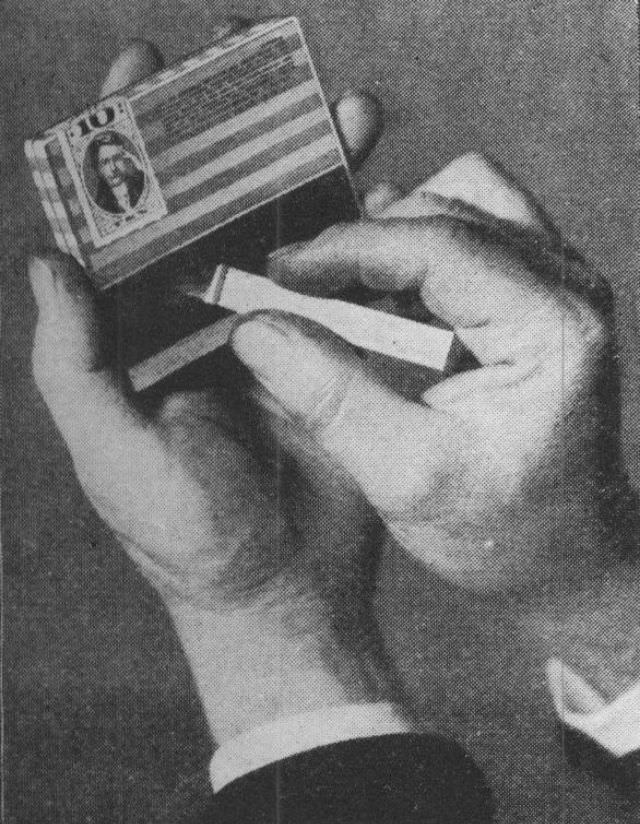
In a pair of close-set hands, a small cigarette box with bold stripes is held like a magician’s prop, while a single cigarette is poised to do something unexpected. The title points to the novelty: a cigarette designed to be lighted by scratching its end, borrowing the familiar logic of a match and folding it into an everyday habit. The grainy, up-close framing keeps attention on the simple mechanics of the idea—portable, fast, and meant to work without a separate lighter.
The 1931 context matters, because the early 20th century was a golden age of consumer inventions that promised convenience in pocket-sized form. Here, the photograph reads like a demonstration shot from an advertisement or news feature, where the “how” is as important as the “wow.” The composition—box, fingers, and the cigarette held at an angle—invites the viewer to imagine the scratch, the flare, and the small triumph of a clever design.
For readers interested in vintage inventions, smoking history, or the evolution of everyday objects, this historical photo offers a concise glimpse into innovation culture between the wars. It also underscores how product design chased self-sufficiency: fewer accessories, fewer steps, more immediacy. Whether it was practical, safe, or widely adopted is another story, but the image preserves the moment when an ordinary cigarette was reimagined as its own ignition system.