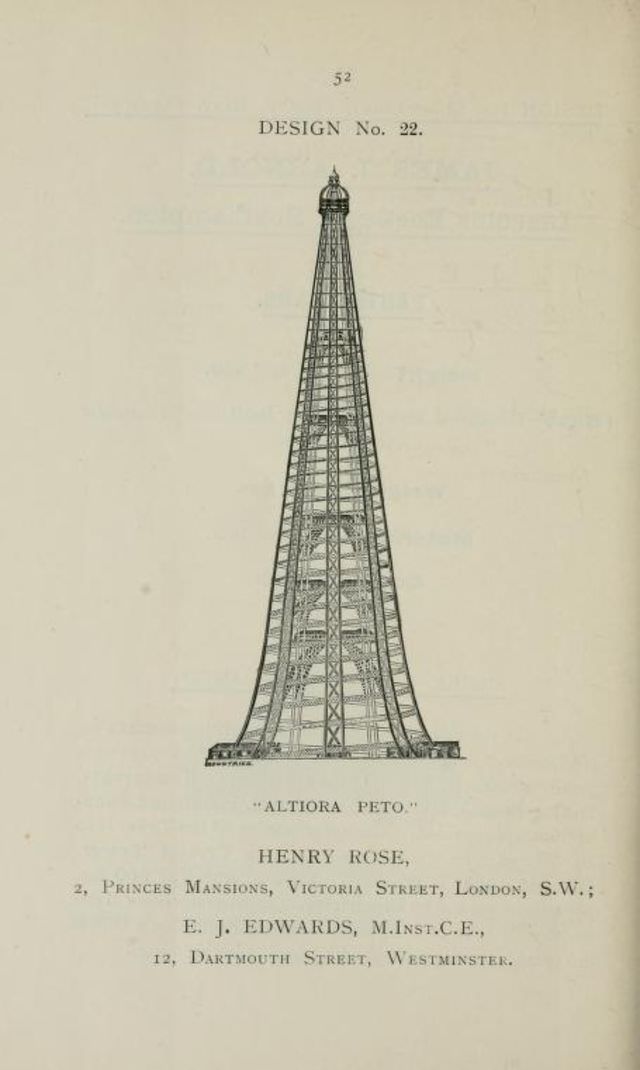
Rising from the page like a needle of ambition, “Design No. 22” proposes a daring lattice tower for London, part of the wave of competitive submissions that surrounded the idea of a “Great Tower” in 1890. The drawing is crisp and technical, with a tapering iron framework, curved lower braces, and a small crown-like cap at the summit that hints at observation space or ornament. Even without a skyline behind it, the silhouette reads as a statement: modern engineering presented as civic spectacle.
Looking closely, the structure’s logic becomes the story—repeating trusses, internal platforms, and a sturdy base that spreads the load before the tower narrows into its soaring spine. The page layout itself feels like a 19th-century pitch: a numbered entry, a centered elevation, and the bold motto “ALTiora PETO” beneath, all designed to persuade judges and the public that this invention could be built, visited, and admired. It’s a reminder that Victorian London was not only preserving history, but also competing to redefine what the city could look like.
For readers exploring “50+ Competitive Designs Submitted For The Construction Of Great Tower For London In 1890 Inventions,” this image offers a window into an era when architects and engineers treated height as both a challenge and a promise. The printed credits at the bottom ground the concept in real professional practice, turning fantasy into a formal proposal. Whether you’re researching Victorian engineering, London architecture concepts, or the broader history of unbuilt monument designs, this single sheet captures the optimism—and rivalry—behind one of the period’s most intriguing architectural competitions.