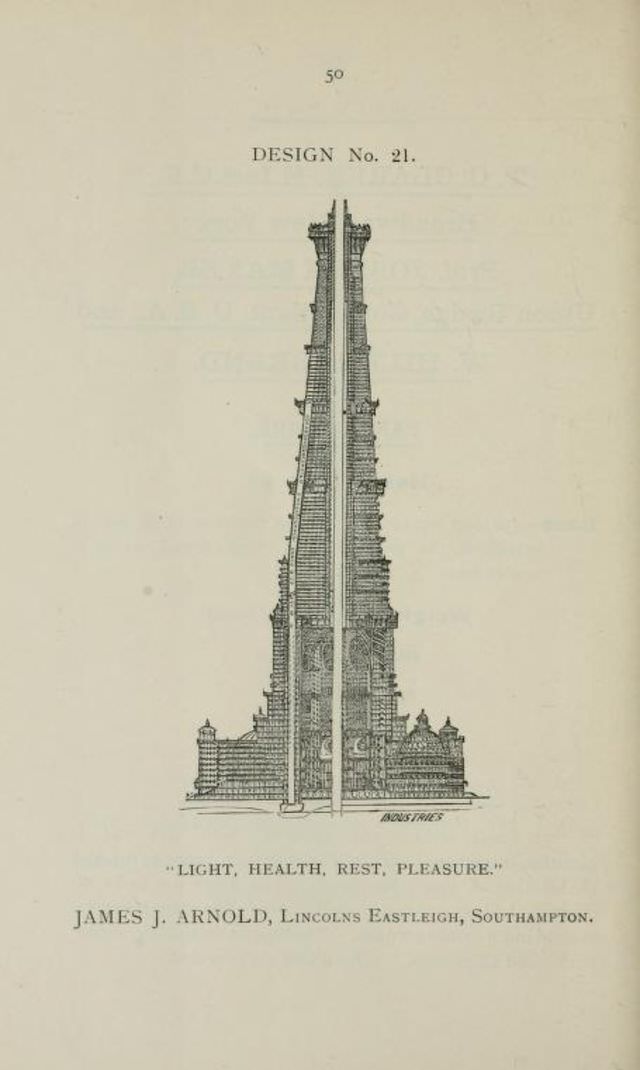
Ambition runs straight up the page in this engraved proposal labelled “Design No. 21,” one of the many competitive submissions imagined for a “Great Tower for London” in the late 19th century. The drawing’s needle-like shaft rises from a broad, busy base, mixing the language of engineering with the ornament of civic architecture. Even without a skyline behind it, the composition suggests a monument meant to dominate its surroundings and announce modernity.
Look closely and the tower reads like a vertical city: stacked platforms, ribbed structural lines, and clustered elements that hint at observation decks and interior circulation. The lower portion spreads outward with symmetrical wings and small domed details, grounding the tall central spine like a grand public building. Beneath the illustration, the slogan “Light, Health, Rest, Pleasure.” captures the era’s faith that inventions and design could improve daily life as well as impress the world.
Presented here as part of a post exploring 50+ competitive designs, the image is a reminder that London’s 1890 tower schemes were as much about ideas as about construction. These proposals reveal what Victorians expected from monumental projects: spectacle, utility, and a promise of progress wrapped into a single landmark. For readers interested in architectural history, industrial imagination, and the invention culture of the period, this print is a fascinating window into a moment when the future was being drafted in ink.