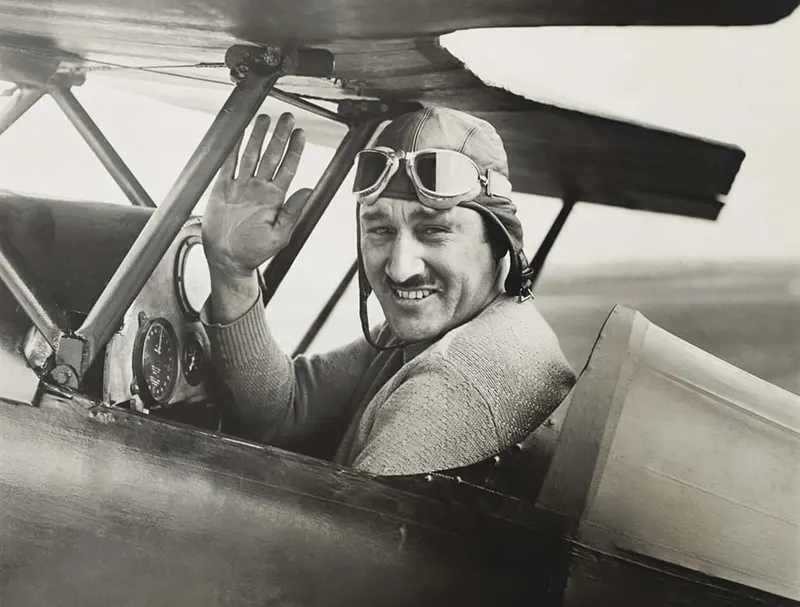
Bert Acosta leans out from the open cockpit of a tiny monoplane, smiling as he raises a gloved hand in a friendly wave before takeoff. Leather flying cap snug, goggles pushed up and catching the light, he looks less like a distant figure from the past and more like someone you might meet on the airfield fence line today. The close framing pulls you into the moment—pilot and machine sharing the same cramped space, ready for the next gamble against wind and weather.
Details of early aviation engineering stand out in the simplest places: the struts bracing the wing, the compact instrument panel, and the thin metal skin of the aircraft that seems barely between the pilot and the sky. There’s no enclosing canopy here, no layers of insulation from noise or cold—just a direct, hands-on relationship with flight that defined pioneering air travel. Even the casual wave carries an edge of bravado, the kind that helped normalize what once felt impossible.
For readers drawn to inventions and the history of flight, this photograph offers a vivid snapshot of the era when small monoplanes and larger-than-life personalities pushed aviation forward. Acosta’s relaxed expression hints at confidence built through repetition, risk, and a deep familiarity with an aircraft that demanded constant attention. As a piece of vintage aviation photography, it works both as a human portrait and as a reminder of how quickly innovation transformed the world—one daring departure at a time.